

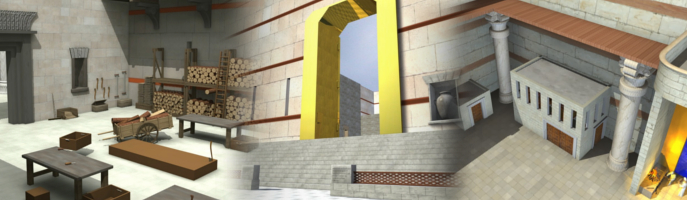

Looking west within the Holy. Inner Altar is in the center.
Separating the Sanctuary from the Antechamber was a 6-cubit (9-foot) thick wall and centered in this wall was the single doorway to the Sanctuary. It had two doorposts and a mantel and measured 10 cubits wide and 20 cubits tall (15 feet by 30 feet). Two sets of double doors were hung in this doorway, one set at the eastern edge of the doorway closer to the Antechamber, and one set at the western edge closer to the Sanctuary. Just in front of the outer doors hung a curtain which was raised and lowered very much like a stage curtain by means of ropes. Normally the curtain was left open so as not to hinder the Kohanim as they came and went from the Sanctuary during the sacrificial service. However, when the Kohen Gadol wished to enter the Sanctuary alone, his assistant would stand outside the doorway and lower the curtain to give him privacy. Upon hearing the bells of the Kohen Gadol’s tunic as he retreated towards the entrance the assistant would raise the curtain once again.
Inside the Sanctuary was the Holy, 20 cubits wide, 40 cubits long, and 40 cubits high (30 feet by 60 feet by 60 feet). As in the Antechamber, the interior was plated with gold and magnificently decorated. Covering the floor were wooden panels plated with gold.
The Holy housed the Menorah [candelabra], the Table [which held the loaves of Showbread], and the Inner Altar [for the offering of incense], with the Menorah in the south, the Table in the north, and the Inner Altar centered between them and slightly off towards the east. In the First Temple, King Solomon fashioned ten copies of both the Menorah and the Table which were arranged in rows of five on either side of the original vessels, and the same practice was followed in the Second Temple.
There were twelve windows in the Sanctuary corresponding to the twelve tribes of Israel. It was common at the time to construct windows with narrow outer openings and wide inner openings, both for security purposes and to allow more light to enter the room. The windows of the Sanctuary were designed with the narrow openings on the inside and the wide openings on the outside to symbolize that the Temple, far from needing light, was the source of light for the world.
_______________
For more information on this topic, and to submit questions or comments for the author, please visit the blog post of this class.