

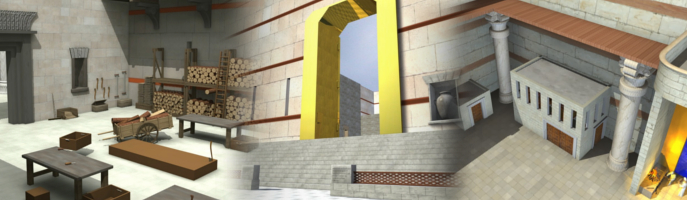
In each wall of the Temple Mount were one or more gateways, all of which conformed to a standard size of 10 cubits wide by 20 cubits tall (15 feet by 30 feet). Instead of a traditional frame consisting of three parts (i.e., two doorposts and a lintel) the Temple gates had additional diagonal elements connecting the doorposts and lintel, resulting in a frame of five parts.

A five-sided gateway of the Temple
Jerusalem was located primarily to the south of the Temple and the majority of the population entered the Temple Mount from that side. To accommodate the large flow of pedestrian traffic two gates were built along this side, spaced evenly across the 500-cubit (750-foot) length of the Temple Mount. These were known as the Chuldah Gates, named after the prophetess Chuldah who delivered her prophesies to the masses just outside the southern wall of the Temple Mount during the First Temple era.
Centered in the western wall of the Temple Mount was the Kiponos Gate. The name Kiponos may represent a contraction of the Greek words kipos (garden) and ponos (work or toil), meaning working the garden, a reference to the garden located just inside this gateway. In this garden, which occupied the area between the western wall of the Temple Mount and the western wall of the Courtyard opposite the Holy of Holies, the Kohanim cultivated all of the ingredients used in compounding the incense offered daily in the Temple.
In the northern wall of the Temple Mount was the Tadi Gate. This gate was unique in that its lintel was not flat but consisted of two stones leaning against each other at an angle such that the top of the gate resembled a triangle.
In the eastern wall of the Temple Mount was the Shushan Gate, so named for the depiction of the city of Shushan which appeared over the mantel of this gate. Shushan was the Persian capital which had hosted the Jews during their exile following the destruction of the First Temple. In appreciation of the ruling power and as a symbol of their allegiance, the Jews placed the Persian emblem over this gate in the rebuilt Temple.