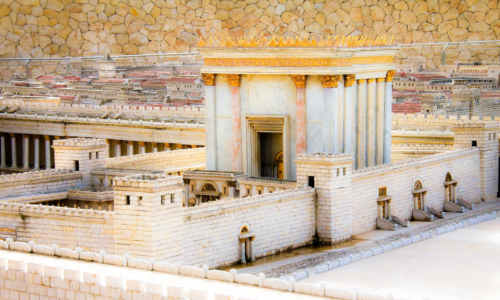
Under the Ezras Nashim (Women's Courtyard)
A priest was once checking wood in the wood chamber
of the Ezras Nashim. According to the Mishna (Shekalim 6, 1) he noticed an unusual floor tile. He investigated, and realized
that buried under the floor was the Aron
Hakodesh (the holy ark)!
He ran to tell others of his discovery, but
before he could reveal exactly where it was hidden, he died.
This is the version in the Mishna in Shekalim.
The Talmud (Yoma 54a) offers two other opinions:
- The Aron was taken by Nevuchadnezzer to Babylonia
- It was buried in its place (under the Holy of Holies).
One thing's for sure: we'll have one
for the third Temple!
What was Tzara'as?
I chose not to translate "Mitzorayim" in the previous
screen because there's no one English word that properly describes it.
The "traditional" translation is leprosy. The problem with that - as so
many of our commentators have pointed out - is that "Tzara'as" bears very
little resemblance to the disease of leprosy.
Tzara'as is not a disease at all. It was
an affliction sent by G-d as a message to improve (usually regarding Lashon Harah
- slanderous talk). The condition worsened or improved
based on the spiritual response of the patient. Even a quick scan of the
relevant chapters (Levit. ch. 13 etc.) will reveal the true nature of Tzara'as.
For good measure, try going through Rabbi S. R. Hirsch's commentary on
the passage.
When the condition had passed, and the patient
had spent his final week in isolation, he came to the Temple to perform
his purification. It was in the chamber of Metzorayim that he prepared
himself.
Today we are all on a relatively low level
of spiritual sensitivity and we probably wouldn't respond properly to the
prompting of Tzara'as. Therefore, G-d hasn't used it for many years.
The Balconies
Every year, on the first night of the intervening days of
the festival of Succos, there would be a great celebration in the Temple.
The thousands of Jews of Jerusalem joined with countless visitors from
around the country, and by torch-light watched the dancing, juggling and singing
in appreciation of the G-d's kindness to His people.
Originally, the men danced and celebrated
on the Temple Mount while the women watched from inside the Women's Courtyard. The sages saw that the intermingling could lead to
light headedness, so they switched it around (the men inside and the women
outside - presumably so that the women could arrive after the men and leave
earlier so as not to actually pass each other).
This, too, caused problems, so the sages finally
decided to build balconies along the inside walls of the Women's Courtyard.
The women stood (or sat) on top and the greatest of the men danced below.
(Incidentally, from here we learn the need for a Mechitza - a divider between
men and women in synagogue).
There were stairs leading up to the balconies
(these too were temporary, as were the balconies themselves) and special doors
on the north and south walls of the courtyard (called Sha'arei Nashim)
through which the women would come and go.
Rabbi Boruch Clinton teaches at the Ottawa Torah Institute yeshiva high
school and Machon Sarah high school for girls (both in Ottawa, Canada).
You may reach him with comments and questions at
bclinton@torah.org.
You can now read some of Rabbi Clinton's essays on Torah life at
http://www.ncf.ca/~es625/essays
You can also buy his collection of essays on
the Book of Shmuel (Samuel) in printed form at
www.lulu.com/marbitzmedia
Copyright © 2000 by Rabbi
Boruch
Clinton and Project Genesis, Inc.