

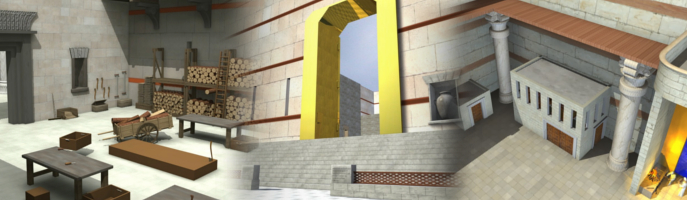
 The Courtyard of the Temple is called Azarah, from the Hebrew word ezrah, meaning aid, a reference to the fact that all Divine assistance comes to the Jews via the Temple. Within its walls the Courtyard measured 135 cubits (202½ feet) from north to south and 187 cubits (280½ feet) from east to west, and this space was divided into different sections. Beginning in the east, the first 11 cubits (16½ feet) of the Courtyard’s length (from east to west) were known as the Israelites’ Courtyard where the public would stand while their sacrifices were being slaughtered and brought to the Altar. Entry into this area was restricted to individuals who were completely tahor.
Adjoining the Israelites’ Courtyard was the Kohanim’s Courtyard, also 11 cubits long, which was used primarily by the Kohanim as they shuttled back and forth between the public in the east and the Altar to the west. Israelites were not permitted to enter here except to perform certain actions related to their offering, such as resting their hands upon the head of the animal [prior to the slaughter], slaughtering the animal [the slaughter was not an official part of the sacrificial service and thus could even be performed by non-Kohanim], or waving the meat [a procedure required of certain offerings].
The Kohanim’s Courtyard was elevated 2½ cubits (3¾ feet) above the Israelites’ Courtyard and these two areas were separated by four steps running the entire width of the Courtyard. The first of these was a large step, 1 cubit (1½ feet) high and 1 cubit deep, and marked the point beyond which all non-Kohanim should not enter (the step itself was located within the Kohanim’s Courtyard).
Above the large, 1-cubit step was a flight of three standard steps â each half a cubit (9 inches) high and half a cubit deep â which together formed a platform called the Duchan. The Duchan was used on a daily basis by the Levi’im who would stand upon it as they provided musical accompaniment for the sacrificial service. In addition, when the Kohanim would deliver the Priestly Blessing (which they did each day in the Temple), those who could not find a place to stand upon the steps of the Antechamber would stand upon the Duchan.
To the west of the Kohanim’s Courtyard was a section 32 cubits (48 feet) long which was occupied by the Outer Altar and all of the associated structures needed to slaughter and skin the offerings and prepare the different cuts of meat for burning upon the Altar. Beyond that was a section consisting of the 22 cubits (33 feet) between the western face of the Altar and the eastern face of the Antechamber and was aptly termed the Area Between the Altar and the Antechamber. This area contained the steps leading up to the Antechamber as well as the Laver from which the Kohanim would wash their hands and feet prior to beginning the sacrificial service. The largest section of the Courtyard was occupied by the Sanctuary Building (which includes the Antechamber) and measured 100 cubits (150 feet) from east to west. The last section of the Courtyard consisted of the 11 cubits (16½ feet) between the western wall of the Sanctuary Building and the western wall of the Courtyard.
_______________
For more information on this topic, and to submit questions or comments for the author, please visit the blog post of this class.