

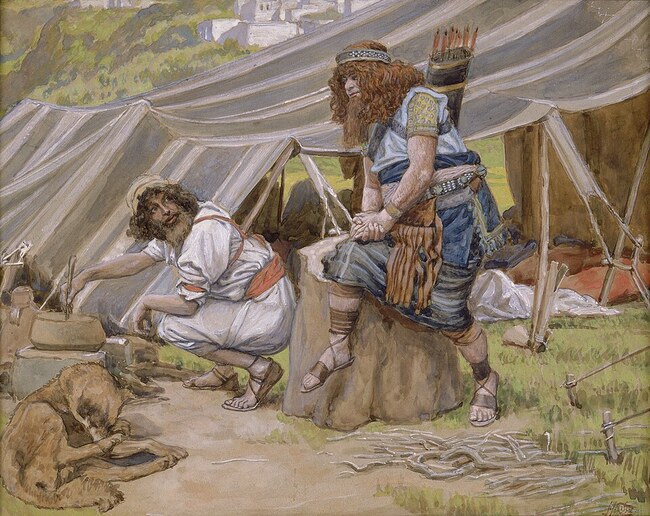
Behold! I am walking towards my death. For what do I need the right of the first born?[2]
Rivka recognized the extent of Esav’s faults. Yitzchok the blind was missing some of the pieces. He recognized that his two sons were essentially different. Still, the Torah reports that he had greater love for Esav![3] Knowing how much was riding on the bracha he was about to confer, how could Yitzchok be so far off the mark?
I believe that Yitzchok understood and appreciated Yaakov’s tzidkus. But he saw Esav as a fighter, someone with strong inclinations towards evil, who needed to expend huge energy in resisting it. It came easy to Yaakov; Esav had to struggle. Hashem rewards struggle; Esav was entitled to both respect and the assistance of his (Yitzchok’s) bracha. (The Torah writes that Yitzchok loved Esav because, “game was in his mouth.” This means that Yitzchok saw Esav’s hunting as a commendable attempt by his son to sublimate his violence and yearning for adventure into something positive.)
Rivka better understood just how far Esav’s evil leanings took him. She loved Yaakov for his good, reflecting Rambam’s position in Shemonah Perakim that the chasid who never had to fight off any inner tendencies towards bad midos and despicable actions is to be preferred over the person who needs to battle against these things.
Furthermore, Yitzchok had reservations about Yaakov’s role as a potential mentor of the masses. An awe-inspiring tzadik cannot easily guide people who see themselves as far removed from his inner universe. They are reluctant to intrude on his holy space, and cannot seek his guidance in important matters. They would be much better served by an Esav-leader, with whom they could relate.
So it seems that the words in our pasuk, “I am walking towards my death” have enormous consequence. Yitzchok looked upon Esav’s leanings to a life of risk-taking, courage, and strength as important assets for someone who could move the mesorah of Avraham and Yitzchok to the next generation at that time. He looked upon Nimrod’s success as a leader (albeit for the wrong cause) as instructional. The leader must be approachable to the masses, not a distant object of reverence.
Esav understood it quite differently. Yaakov explained to his brother what the role of public oveid Hashem necessitated. The icon of avodah would have to restrain himself constantly. He could not manifest or act upon his primitive tendencies. Even his thoughts would need constant retooling. He could not have the luxury of approaching the world according to his own thoughts and musings. The oveid Hashem would have to move his most private thoughts closer to an ideal imposed from outside himself.
Esav looked upon these constraints as nothing less than death! At that point, it became easy for him to spurn the birthright.