

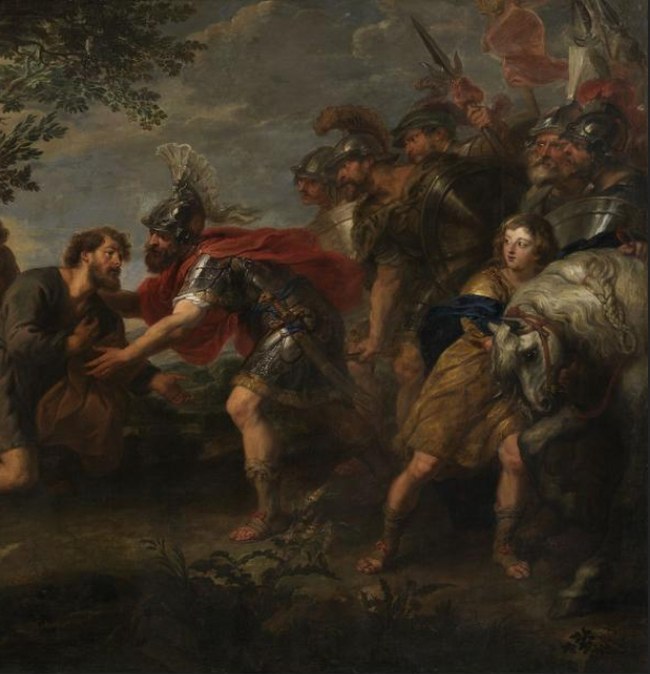
Now deliver me from the hand of my brother, from the hand of Eisav, for I am afraid of him, lest he come and strike me, a mother with children. (Breishis 32:12)
And Yaakov named the place Peniel, for, “I saw an angel face to face, and my soul was saved.” (Breishis 32:31)
And he went ahead of them and prostrated himself to the ground seven times, until he came close to his brother. And Eisav ran toward him and embraced him, and he fell on his neck and kissed him, and they wept. (Breishis 33:3-4)
Yaakov is anxiously anticipating the confrontation with Eisav as he returns to Eretz Yisrael. Yaakov is vulnerable, loaded down with women and children, while Eisav is presumably hostile. So, Yaakov employs a few all-time classic strategies that remain as models for us to follow. We know that he prepared for the possibility of war, he sent gifts to soften Eisav, and he prayed to HASHEM. Part of his prayer included the petition, “deliver me from the hand of my brother, from the hand of Eisav…”. Why does he refer to Eisav both as his brother and by his proper name, Eisav? We know and HASHEM knows that his brother is Eisav.
It could very well be that this reference may be revealing another deep and subtle tool in his arsenal, as King Solomon writes, “With strategy make for yourself war”. What is the advantage that Yaakov is quietly trying to attain here? Again, King Solomon spells out a formula for success in human relationships.
This is really and truly the path to winning friends and influencing people. As in water, face is to face, so is the heart of a man to a man. (Mishlei 27:19) How people feel about us is often a deep reflection of how we really feel about them. How can we change the way people feel about us? Change the way you perceive them.
A Russian peasant farmer who never left the small and parochial surroundings of his town came to the big city of Moscow. He arrived at an elegant hotel with mud on his boots and overalls looking wild. The concierge assigned him a room on the top floor. With key in hand, he started the long climb to the hotel room. On the first landing there was a full-length mirror. The man who had never seen himself before was suddenly startled and frightened by the imposing image before him. He growled and barked to scare him away only to find that the image in the mirror was threatening as well. He ran to the next floor and confronted the fearsome giant again exchanging harsh looks. On the third floor they stood nose to nose and exchanged warring postures.
Realizing that there was nowhere to escape this beast-like fellow who was aggressively stalking him in the hotel he ran quickly back to the lobby and the front desk to file a complaint. After having given a detailed description of the perpetrator the man at the desk understood that he had met the enemy and it was the man in the mirror.
He said, “The fellow who you confronted is here to protect people. He is really quite harmless. Trust me. If you show him a harsh and angry face, he will do the same. However, if you just smile pleasantly and continue on your way he will nod and smile at you as well. Enjoy the rest of your stay.”
Yaakov worked in his heart of hearts on finding that brotherly connection to bypass his hostile exterior. PANIM means faces but P’NIM means inner. The face is a clear window into the inner world. It could be that when Yaakov wrestled with the arch-angel of Eisav it was a face to face (Peniel) battle to alter Eisav’s attitude. When he did approach Eisav the result was surprisingly different than anticipated. He prostrated himself to the ground seven times, until “he came close to his brother” and Eisav fell on his neck and cried. Instead of hand to hand combat it was a face-to-face meeting.