

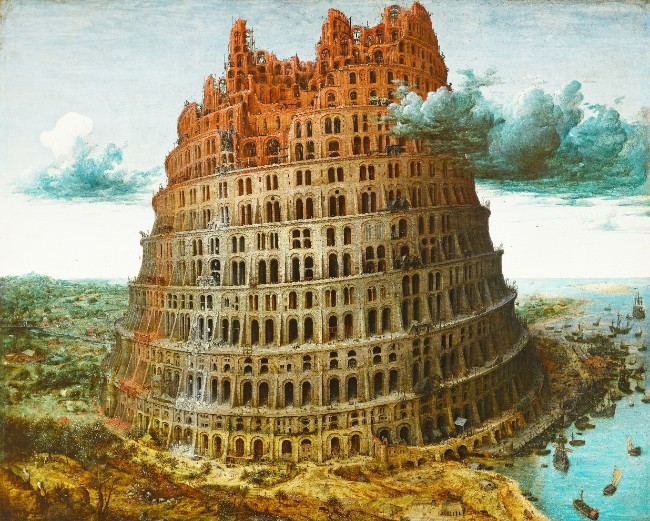
THE ENTIRE EARTH spoke one language and had uniform words. Who doesn’t take speech for granted, except for the person who can’t use it? It is such an automatic process that most of the time we’re not even conscious that we’re using it. We think something, need to communicate it, and just do. It’s only when we don’t, that is, when our message doesn’t hit home, that we feel the reality and potential limitation of words.
Communication is the grease of life, whether we’re talking to others or just to ourselves. It’s what makes things work together in sync and run smoothly. The right words at the right time can have an amazing effect, whereas the wrong ones can have a catastrophic impact for years to come. Hitler, ysv”z, managed to manipulate an entire generation of intelligent people to do his unintelligent bidding with words.
As a writer, you learn to appreciate words quickly. It’s annoying to make mistakes, but sometimes the omission of just one word changes so much, like leaving out the word “not” to say what was missing and saying instead that it wasn’t. Even a single letter can change everything, like writing “hear of God” instead of “fear of God” in last week’s Perceptions. Fortunately, others caught it.
Probably writing has greatly improved my vocabulary. When you write, you have to consciously choose your words, which makes you think about finding better ones, or more specific words. Recently, when I challenged AI’s conclusion about something, I found myself explaining myself with a much richer vocabulary than I normally use. I think I was trying to impress it.
The Hebrew word for “word” is usually “milah,” as in Bris Milah. This might seem a little strange on a simple level, but in Kabbalah the tongue is considered to be the Yesod, the place of Bris and one of the sefiros, on a higher level. Therefore, there is also something called “Bris HaLoshon—Covenant of the Tongue.” It’s kind of an unspoken agreement, tongue-in-cheek intended, that we have with God to use our speech in a holy and trustworthy manner.
In fact, the Gemara warns against not keeping one’s word and, parsha-appropriate, says: “He who exacted retribution from the Generation of the Flood and the Generation of the Dispersion will exact retribution from one who does not keep his word” (Bava Metzia 44a). Why reference the Flood and the Dispersion? Flood in Hebrew is “mabul,” and the tower was built in “Bavel,” both words from the same root that means “confused,” what happens when speech is not used to communicate truth. When language is detached from truth, society structurally collapses.
Another Hebrew word for “word” is teivah, which can also mean “box,” like the one Ya’akov Avinu hid Dinah in to keep her safe from Eisav (Bereishis Rabbah 76:9), or ark, like the one Noach boarded in this week’s parsha to survive the Flood. That’s got to mean something.
It does. A word is like a box with a message inside of it. Until a person speaks, we don’t know what they want to tell us. The message remains hidden in their thoughts. But, once they choose the right words to convey their message, their thoughts are revealed and we become aware of something we may not have known before, or confirm what we did.
So, just as the ark protected life from the chaotic waters, a carefully chosen word packages and protects a hidden spiritual thought until it is safely delivered to the listener. A simple statement like, “Watch out!” can transfer their recognition of danger into someone else’s and save a life.
The Zohar says that you can tell what a person is like by how they speak, so if talk is cheap, then so is the person who thinks so. Even though actions can speak louder than words, they can also appear to express the wrong ones. This is why, as the Gemara points out, we have a mitzvah to judge a person to the side of merit (Shabbos 97a). What we see is not always what we get.
But unless a person deliberately disguised their message, words are a good indicator of a person’s approach to life. This is because speech is what we gained when God breathed a soul into Adam’s lifeless body. This makes speech a function of the soul (dead people can’t speak), but the spiritual quality of a person’s speech is the measure of the proportion of soul input into their speech versus body input at any given moment in time. It’s kind of a spiritual thermometer.
Every now and then I am asked to contribute to a weekly parsha presentation along with five other writers. We are given the same verse to explain, but allowed only 250 words with which to do it. The fun part is going over the paragraph after having said what I wanted to say and editing out words and phrases that can be deemed unnecessary to bring the final count down to 250 without losing the depth of the message. It’s a good thought exercise and word discipline.
Try it. Start writing down ideas that you might want to share with others, perhaps at the Shabbos Table. That alone is a great thing to do. But then edit, impose restrictions on how much you say and how you say it. It’s fun and good brain exercise which, given the direction of society today, we can’t get enough of.
Newest Books: Heaven to Earth (on the ten sefiros, life, and history) and “Redemption Therapy” on coping with the changing world in preparation for the Final Redemption. Both, as the rest of the books, are available through Amazon or my site, Thirtysix.org.
Have a great Shabbos,
Pinchas Winston