

This dvar Torah was adapted from the hashkafa portion of Rabbi Yissocher Frand’s Commuter Chavrusah Series on Parshas Noach: #1485 – I Just Saw a Rainbow – Should I Tell My Neighbor? Good Shabbos.
The pasuk says, “Vayomer Elokim zos os habris asher ani nosein beini uveineichem ledoros olam.” (9:12) The Ribono Shel Olam says about the rainbow, I am placing between Me and you the sign of the covenant for all generations.
There is an interesting Medrash Rabba in Parshas Noach, parsha 35 os 7 that points out that the word ledoros (for generations) is written chosser (lacking). Normally, it is written with letter vavs: dalet-vav-reish-vav-sof. Here it is written chosser – without letter vavs: dalet-reish-sof. The Medrash quotes Rabi Yuden, who said, “The word ledoros is written without the vavs to exclude two generations.” Two vavs are missing, representing two missing generations. The Medrash says that the rainbow did not appear during two generations.
The Gemara asks, “Which were those two generations? The dor (generation) of Chizkiyahu and the dor of the Anshei Knesses Hagedola.” There were no rainbows during the dor of Chizkiyahu Melech Yehuda (the king of Yehuda) because Chizkiyahu Melech Yehuda was a tzaddik yesod olam. Tzaddik yesod olam is an expression that means a tzaddik upon whom the world rests. That was the level of Chizkiyahu Melech Yehuda. The Ribono Shel Olam wanted to make Chizkiyahu into Mashiach. There was never a rainbow in his dor because the tzidkus (righteousness) of Chizkiyahu overwhelmed any accusation against the people.
The other dor in which there were not any rainbows is the dor of the Anshei Knesses Hagedola. The Anshei Knesses Hagedola, as we know, consisted of 120 gedolei hador (greatest of the generation), including nevi’im (prophets), who established the nusach hatefila (text of the prayers). Their zechus (merit) was so overwhelming that never in their dor did the Ribono Shel Olam bring a rainbow because He never contemplated destroying the world. Rabi Chizkia says no, the second generation in which there was never a rainbow is the dor of the Tanna Elokai, Rabi Shimon bar Yochai. Again, he was such a tzaddik yesod olam that there was never a rainbow in his generation.
The Medrash says that Eliyahu Hanavi was learning b’chavrusa (in a twosome) with Rabi Yehoshua ben Levi. Suddenly, they came across a statement from Rabi Shimon bar Yochai. Eliyahu said, the ba’al ha’memra (the author of this teaching) himself said it. Let us go and ask him. In other words, Rabi Shimon bar Yochai is around, he’s the author of this teaching. Let’s go ask him what he meant. Let’s ask him to explain it.
Eliyahu Hanavi went into Rabi Shimon bar Yochai. Rabi Shimon bar Yochai asked him, “Who is with you?” Eliyahu answered, “The gadol hador (greatest of the generation) is with me, Rebbi Yehoshua ben Levi.” Rabi Shimon bar Yochai asked him, “Did a rainbow ever appear in the days of Rebbi Yehoshua ben Levi?” Eliyahu answered that yes, there were rainbows. Rabi Shimon bar Yochai said, “If a rainbow appeared in his days, he is not worthy that I should see his face.” Since there was a rainbow in Rebbi Yehoshua ben Levi’s days, I don’t want to see him, because he’s not a tzaddik yesod olam – a tzaddik gomur (complete). A rainbow will not appear during the days of a tzaddik gomur. Therefore, Rabi Shimon bar Yochai didn’t want to see him. A similar Gemara in Maseches Kesubos basically says the same idea regarding rainbows during the time of Levi bar Levi.
However, this concept seems to contradict the pasuk “Noach ish tzaddik tomim hayah b’dorosov” (Noach was a perfect tzaddik in his generation). If Noach was a perfect tzaddik, why did a rainbow appear during his days?
Reb Yoshe Ber Soloveitchik says that it must be that this Medrash about a rainbow not appearing during a dor that has a tzaddik yesod olam must be going like that famous Rashi in the beginning of Parshas Noach that says that had Noach lived in the generation of Avraham Avinu, he would not have been considered significant.
Why, in fact, was there a rainbow during the days of Noach? Why was Noach not a tzaddik yesod olam? The reason is because Noach did not protect his dor, so he was not a tzaddik yesod olam, in whose time a rainbow would not appear.
In fact, the Zohar says that the Ribono shel Olam had a tayna (criticism) on Noach. Why didn’t you daven (pray)? You were building the teiva for so many years, why didn’t you daven? Why weren’t you mashpia (influence) on your dor? The Zohar concludes that it was because Noach held that his dor was so incorrigible and beyond redemption that there was no point in davening. There was no point in trying to be mashpia.
In fact, Rav Meir Shapiro adds that if you don’t believe in the basic goodness of someone, you’ll never be mashpia on him letova (for good). If you’re convinced that a person is beyond redemption then nothing is going to help. That, in fact, is what happened with Noach. He was not successful because he held in his heart of hearts that the people were incorrigible.
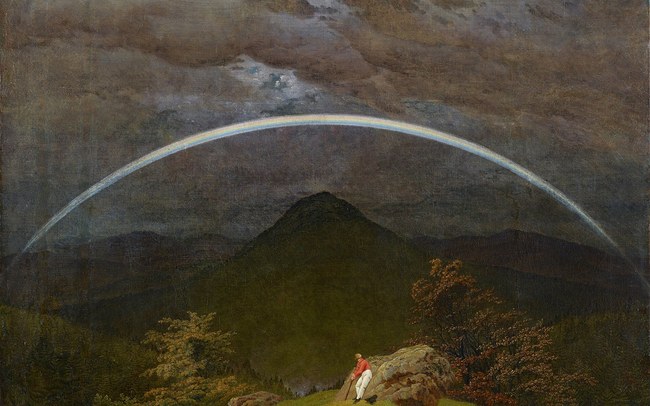
Reb Yoshe Ber Soloveitchik says that this is the symbolism of the rainbow. When the Ribono shel Olam brings a rainbow during the dor of Noach, what is He teaching Noach? Hashem is teaching Noach that when everything appears dark, and a person appears to be so far away, so rotten and dark, in the midst of that darkness, light can appear. That is a rainbow. A rainbow occurs after it suddenly turns black outside. Lights that are on light sensors will even turn on in the middle of the day because it’s so dark. Then it rains. Then the clouds dissipate and the sun comes out, and then you see the rainbow. The message is that no matter how dark it may be, there can always be light. It may be hidden, and it may not be very visible, but there’s always light. The tayna on Noach is that he failed to appreciate the potential of his dor.
That is why the mabul (flood) is referred to in Sefer Yeshayah as Mei Noach (the waters of Noach). Why Mei Noach? Because there’s a tayna on Noach. The tayna on Noach is that he did not do enough for his dor.
I want to perhaps suggest that this Rabbi Yehoshua ben Levi is lishitoso (consistent with his point of view elsewhere) that you should never give up on someone, no matter how beyond hope the person appears to be. We see this in the famous Gemara in Maseches Brachos on daf 27b-28a, regarding a machlokes (argument) between Rabban Gamliel and Rabbi Yehoshua. They decided to remove Rabban Gamliel from the position of the nasi. The Gemara says that they appointed Rabbi Elazar ben Azarya instead. This is the famous Gemara about Rabbi Elazar ben Azarya becoming the nasi when he was only eighteen years old and his beard turning white overnight. We’re familiar with the story from the Haggadah.
The Gemara says that the day that Rabbi Elazar ben Azarya became the nasi, there was a change in policy about who they accepted into the yeshiva. Rabban Gamliel would publicly proclaim, “Any talmid (student) who is not tocho k’baro (his inner character is not like his outward appearance) may not enter the beis hamedrash.” Rabbi Elazar ben Azarya had a different shita (point of view). He said no, we don’t need to have such high quality standards. The Gemara says that after they removed the guard from the beis hamedrash, hundreds of benches were added because hundreds of additional talmidim now came into the yeshiva. The Gemara says that Rabban Gamliel became depressed. “Perhaps, chas v’shalom, I withheld Torah from Klal Yisrael.”
“There had been a hundred bochrim in the yeshiva. Now there are seven hundred bochrim in the yeshiva. Am I going to be held accountable for withholding Torah from all these talmidim?” He had a dream that night, in which, he saw white pitchers full of ashes, as if to say, “You are right, those talmidim were really not worthy.” But that was not really so. He was merely shown this in order to put his mind at ease. The truth of the matter is that Rabban Gamliel was wrong.
The Chiddushei Harim, the first Gerer Rebbe asked, why did Rabban Gamliel feel bad? This is his shita. He held that the talmidim need to be tocho k’baro. He saw those seven hundred applications. He did not suddenly have this epiphany, “Oh look, I could have had so many more talmidim.” He saw those applications. That was his shita. He may have been wrong, but at least he should not suddenly say, “Oh look what I could have had.”
The Chiddushei Harim explains that once the talmidim came into the beis hamedrash, they became different people. Rabban Gamliel was right, they were not tocho k’baro. But Rabban Gamliel himself did not realize the amazing power of what Torah can do to a person. That is what happened, and that’s why Rabban Gamliel was depressed.
Rabban Gamliel was appeased by the white pitchers with ashes inside, but the truth of the matter is, he was wrong because he did not appreciate the effect of the Torah on the talmidim who were not yet tocho k’baro.
Rav Yoshe Ber Soloveitchik explains that when ashes look all burnt out, there can always still be a spark in there. If you blow on the spark, you might actually relight the fire. That was the true meaning of the mashal (parable) of the white pitchers full of ashes. Ashes may look like they’re all burnt out, but there can still be a spark in there. Noach and Rabban Gamliel failed to recognize that potential.
Dovid Hoffman; Baltimore, Maryland; [email protected]; Editor
David Twersky; Jerusalem; Editor Emeritus
This week’s write-up is adapted from the hashkafa portion of Rabbi Yissocher Frand’s Commuter Chavrusah Series on the weekly Torah portion. View a full listing of the halachic portions for Parshas Noach.
A complete catalogue can be ordered from the Yad Yechiel Institute, PO Box 511, Owings Mills MD 21117-0511. Call (410) 358-0416 or e-mail [email protected] or visit http://www.yadyechiel.org/ for further information.