

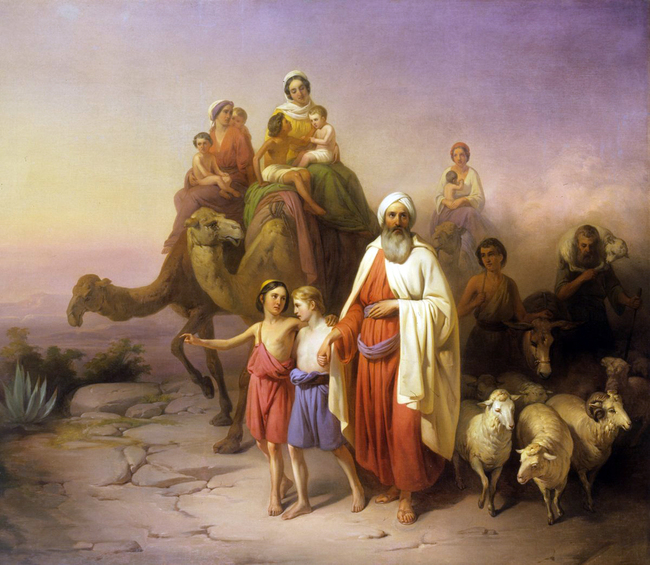
GOD TOLD AVRAM, “Leave…and I will make your name great…” (Bereishis 12:1–2). Wait, wasn’t having a name the problem with the people who built Migdal Bavel (Tower of Bavel)?
They said, “Come, let us build ourselves a city and a tower with its top in the heavens, and let us make ourselves a name…” God said, “ [They are] one people, and they all have one language, and this is what they have commenced to do?” (Bereishis 12:4, 6)
The difference is subtle but important. God didn’t say anything about making a name for Avraham, as the people of the tower planned to do for themselves. God only promised to make the name that Avraham already had bigger, greater. It’s an important difference.
People often talk about making a name for themselves in this world. Similarly, they speak about leaving their mark on history. They seem to have this fear of being forgotten after death or overlooked while still living. Having a name for themselves becomes a form of self-validation. It is obviously not a foreign idea. The mishnah in Pirkei Avos addresses it:
If one acquires a good name, he has acquired something for himself. (Pirkei Avos 2:5)
Rebi Shimon says: There are three crowns: the crown of Torah, the crown of priesthood, and the crown of royalty, but the crown of a good name supersedes them all. (Pirkei Avos 4:13)
This, of course, is not talking about the name your parents give you at birth, which, the Arizal says, is a function of Ruach HaKodesh—Divine Inspiration (Sha’ar HaGilgulim). Parents may choose the Jewish names of their children, but it is Hashgochah Pratis that arranges it, in one way or another, for them to arrive at their choice. This shows that Jewish names are not random or mere convention, but some kind of description of the spiritual element of the person.
In fact, inherent in the spelling of the word is a nice insight. The same letters of “shem—name,” Shin-Mem, also spell “shum—there,” as in, “over there.” A name is a way to “locate” someone, not just in space and time, but in life itself. Hebrew words are comprised of Hebrew letters, each of which expresses a particular concept. We may not always know how, but a Hebrew name “locates” a person spiritually, hinting at their spiritual potential that may not yet have been realized.
Now, when most people talk about making a name for themselves, it usually means one they think is important. They think about doing something that impresses others and will draw attention to them and what they have done…something that is beyond ordinary so that people they respect will respect them too. It has little to do with their “personal” name, the one that may describe the uniqueness of their soul, and more to do with what other people admire. That’s what the people of Migdal Bavel had in mind when they initiated their ambitious project.
Clearly, though, it was not a name that the one they needed to impress the most, God Himself, admired. On the contrary, not only did God have no interest in making their acquired name great, He didn’t want any of it to actually happen and promptly dismantled the apparatus they had built to achieve it. And He has done the same to many similar others throughout history.
Therefore, when God promised to make Avraham’s name great, He obviously referred to his real name, not the one he gave himself but the one he grew into by becoming Avraham Avinu. And by God Himself adding a Heh to Avram, a Heh to Sarai, and later revealing the Yud in Pinchas’ name, God made it clear that they had truly made their name for themselves, earning it by growing into it through their service of God.
Someone once told me that he had known his Hebrew name since his days in a Conservative cheder. Being secular, he rarely ever used it, but on the few occasions he had to, he would cringe upon hearing it. He just didn’t like the name he had been given, but he never used it enough to want to change it.
Many years later, he unexpectedly found his way to Torah Judaism and even to a yeshivah to learn Torah full time. He had still gone by his English name, but one of his Gemara rebis insisted on calling his students by their Hebrew names, which he begrudgingly divulged. His rebi smiled upon hearing it said, “It suits you.”
It took a little time getting used to being called by his Hebrew name, but eventually he started to relate more to his given Hebrew name than his English one, and went by it. He had forgotten how he had once felt about his name and, instead, started to identify with the Biblical character of the same name. The more he did, the more he felt at home with himself and, today, being called by his English name carries the original effect that earlier had been attached to his Hebrew name.
The Arizal says (Sha’ar HaGilgulim) that when a person dies, angels come to his grave and ask him his name. If the deceased can correctly answer the question, then they are saved from a difficult transition to the next world. If not, they learn their correct name the hard way.
But, the Arizal explained, it is not the name your parents gave you at birth that they ask for. Because everyone remembers that. It is the name of their yetzer hara, of their personal weakness the person had reincarnated to rectify. Knowing that name means the person worked on themselves during their lifetime, and therefore they do not have to suffer much more in the grave. Not knowing the name means the person passed up personal rectification for the pleasures of the previous world and does not have to pass a very unpleasant “make-up exam” after death.
But part of knowing that name is knowing your soul’s name. Because it is only by understanding who you are supposed to be that you can recognize when you have become something else. And God only builds relationships with real people, not imitation ones, and that is one of the first and most important messages we learn from the first few lines of this week’s parsha.
From “Heaven to Earth” about the ten sefiros and “Redemption Therapy” about contemporary issues on the way to redemption are both good to go through Amazon. If you plan to order and want a 15 percent discount, write me at [email protected].
Good Shabbos,
Pinchas Winston