

GOD TOLD AVRAM, “Leave…and I will make your name great. Bris Milah changed everything. It’s not so clear from the parsha, but it will be at the end of history.
The story picks up where it left off last week, just like those attending the Bris move on to the seudah after the baby’s grand exit without very much consideration for what just happened. It was just another Bris, and indeed it was, millions having been performed since Avraham carried out the first one. The rite of passage earned, another baby boy has been inducted into the original covenant.
All that is true, but so much more as well. But, if you don’t appreciate how history works, then the significance of Bris will go right over you. Because, so much of what Bris does for the world happens below the surface and behind the scenes. You have to go there to see all the incredibly dynamic impacts that a single Bris has on Creation and world rectification.
Yechezkel, when talking about the final redemption, says:
And I will give you a new heart, and a new spirit will I put within you, and I will take away the heart of stone out of your flesh, and I will give you a heart of flesh. (Yechezkel 36:26)
Obviously, the prophet was not talking about national open-heart surgery, at least not in the physical sense. Rather, he was talking about national milah on the heart, as the Torah put it:
And God, your God, will circumcise your heart and the heart of your offspring, [so that you may] love God, your God, with all your heart and with all your soul, for the sake of your life. (Devarim 30:6)
This means that the difference between a heart of stone and one of flesh is not the heart itself, but what encases it, some kind of spiritual orlah. Some say it’s a good thing too because we could never have emotionally survived all that we have gone through as a nation if we had had flesh hearts. But, quite frankly, we haven’t really survived all of it even with hearts of stone. Then again, had we not lost our hearts of flesh, maybe we wouldn’t have gone through all that we did in the end.
When did we lose our hearts of flesh in the first place? The Gemara says that Adam HaRishon had been created without any orlah, and that he created it for himself after his sin (Sanhedrin 38a). Of course, anything to do with Adam HaRishon and his chet is rarely what it seems to be on the surface, and tends to be kabbalistic, which the GR”A confirms by explaining it means he lost his intellectual clarity. And this basically amounted to a head-heart disconnect that we were expelled from Paradise to fix.
How do we do it? You’d think that learning Torah would be enough, but it turns out that it’s not. Eventually we realized that and began something called the Mussar Movement to work on reconnecting head and heart, mind and Menschlichkeit. But that’s just a more recent name for something the Torah addresses all the way back at the beginning: Derech Eretz.
The Torah says:
And God sent him out of the Garden of Eden, to till the soil, whence he had been taken. And He drove the man out, and He stationed from the east of the Garden of Eden the keruvim and the blade of the revolving sword, to guard the path to the Tree of Life. (Bereishis 3:23–24)
But the Midrash interprets:
Path? That is Derech Eretz. (Vayikra Rabbah 9:3)
From the verse it sounds like we were barred from the Aitz HaChaim. But we know better, because Torah is called “Aitz HaChaim,” and learning it is our life’s mission. With the Midrash’s interpretation we now understand that we weren’t completely barred from the tree; we just can’t access it properly without Derech Eretz, which is what the Leshem also said regarding the Ohr HaGanuz, the light God hid on the first day of Creation and which is the basis of the Torah:
God saw that the light was good, and God separated between the light and the darkness. (Bereishis 1:4)
He saw that the wicked were unworthy of using it, and therefore set it apart for the righteous in the Future Time. (Rashi)
He made a separation in the illumination of the light, that it should not flow or give off light except for the righteous whose actions draw it down and make it shine. However, the actions of the evil block it, leaving them in darkness. This itself was the hiding of the light. (Sefer HaKlallim, Klal 18, Anaf 8, Os 4)
The Leshem didn’t mention talmidei chachamim, because you can be one without being a tzaddik. Likewise, you don’t have to be the biggest talmid chacham to be a tzaddik, just a lot of Derech Eretz. Because it is our Derech Eretz that reveals how much our Torah has made the journey from our heads to our hearts, how much it has broken through the “orlah” that blocks it. That’s when it moves from the technical level of Chochmah and becomes the all-important Da’as.
And now you can appreciate why the first story to be told after Avraham received his Bris is about Derech Eretz, Avraham being more concerned about wayfarers than his own recovery. That wasn’t just after the Bris. It was because of it, and if you want to know the more complete story, you can see my new book called “Derech and Eretz: Personal Behavior and World Rectification,” available through Amazon or my site, www.thirtysix.org.
Have a great Shabbos,
Pinchas Winston
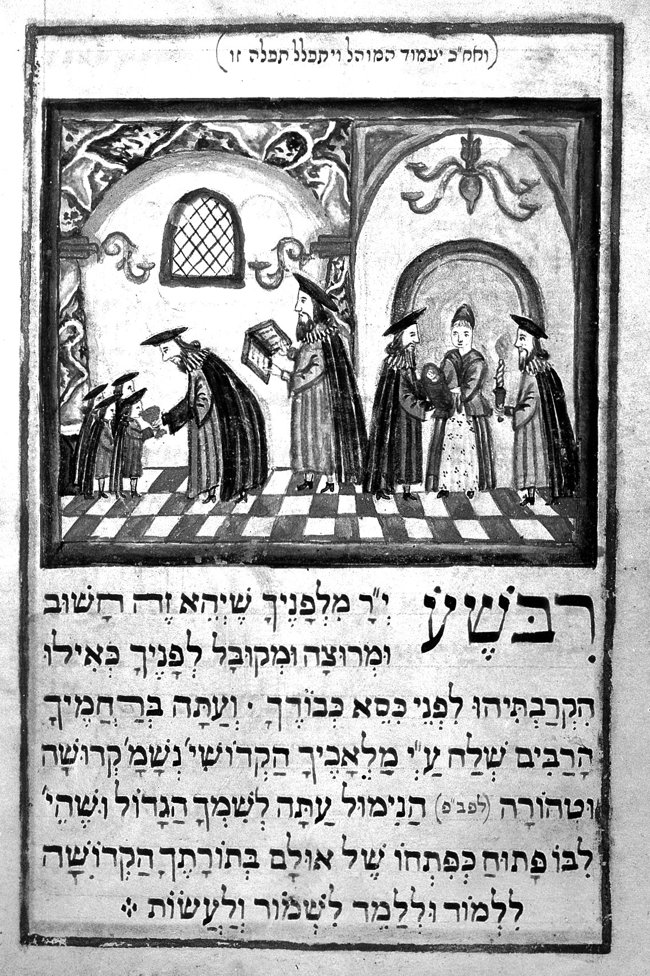
Photo Credit: A circumcision (Bris Milah) ceremony, illustration from the manuscript Secret of HaShem, Wellcome Collection, with CC BY 4.0 license, on Wikimedia Commons.
