

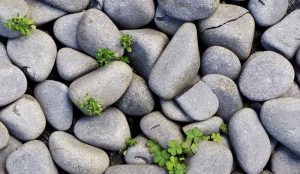
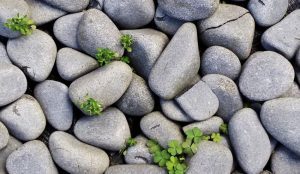
Listen now, you rebels! Shall we bring forth water for you from this rock?[2]
Why does Moshe emphasize “this” rock? Was there something that distinguished the rock right in front of him from any other rock? Shouldn’t his question have been different? “Lots of rocks around here. No water in sight. Think I can convince one of the rocks to give you water?”
Rashi provides a curious part of the background. The specific rock that was intended to provide water moved out of position, and blended in with all the surrounding rocks. Moshe was stymied. The people said, “What’s the big deal? This rock; that rock. It’s all the same. Moshe therefore responded, “Shall we bring forth water for you from this rock?”
In regard to the non-miraculous, different items of the same kind should more or less share the same properties. You would not get hung up about your failure to pluck an apple in season from a specific tree in an orchard. Move on – there are plenty more trees where that one came from. If an oak tree provided apples, however, it would be miraculous. There would be no expectation that some other nearby oak tree would also provide them.
This might explain Moshe’s anger at the people. By claiming that any rock ought to be able to quench their thirst, they clearly were minimizing the miraculous nature of the water. They cut it down to smaller size, as if it were an expected and natural event. Moshe was deeply trouble by this attitude. He immediately corrected them. “Rebels! You speak of water in the wilderness as if it were a natural event for you! Don’t you understand that Hashem provides you through clear miracles? Only one of these rocks was endowed with a miraculous capacity to produce water. Would you like me to bring water forth from this rock – to the exclusion of all others?
Moshe was quite right in immediately zeroing in on this lesson. But it was also a mistake. If the people were downplaying the miraculous, he should have used the opportunity to showcase the miraculous. He should have asked them, “Which of these rocks would you like Hashem to transform into a flowing stream? Pick one, and He will do it!”
Analogous to this is a candidate for a rabbinic position who arrives for a tryout. He can give some great shiur, but he knows that this will prove little. With adequate prep time, many people can come up with a presentation, by “borrowing” one from some collection, or utilizing something they have heard elsewhere. Eager to establish his bona fides, the candidate challenges the crowd. “You name the topic; I will instantly come up with an edifying lecture. Just try me.” That provides striking evidence of his scholarship.
Moshe should have acted similarly, He should have asked the crowd to decide on a particular rock, and brought forth water from it. That would have led to a far greater kiddush Hashem. The Torah faults him for not doing so.
The Alshich observes that the word hamin is used only three times in Tanach. Once occurs in our pasuk. Another is in Bereishis.[3] “Have you eaten from the tree (hamin ha-etz) of the tree from which I commanded you not to eat?” The third is[4] “If Hashem does not help you, how shall I help you? From (hamin) the threshing floor, or from the winepress?”
According to our approach, we can understand the connection. All three share the notion that a specific object has no special potential unless Hashem ordered it that way. Moshe makes this point about a water-giving rock. It had to be a specific rock, not any random one.
Ramban[5] comments that from the very time of Creation, Hashem made certain plants appropriate for humans, and others for animals. In other words[6], without that designation, what we take for granted as human food would offer no sustenance and no pleasure to the person who eats them. When Adam and Chava ate from the etz ha-daas, G-d chides them. “Did you really think that you eating from that tree would give you any satisfaction? Did you not believe that unless I designated it for human consumption, it would offer you nothing at all? (Now, in fact the fruit of the etz ha-daas was delicious – but Hashem’s point was that they properly should have assumed the opposite, and balked at eating it, regardless of its tempting appearance.)
When the king of Yisrael responded to the woman clamoring for food during the severe famine, he said, “Where is it supposed to come from? Do you still look to the threshing floor and the winepress? They are both empty. There is nothing special about either of those places, when they are devoid of contents. Unless they are blessed with the bounty they are expected to hold, they are no different from any other place.”
Miracles do not work like a bank account, from which we can make withdrawals, and use the funds as we like. They are highly specific. Really, so are all of Hashem’s brachos. Seeing them as fungible diminishes their value.
- Adapted from Divrei Shaul, by Rav Yosef Shaul Nathanson, the Sho’el U-Meshiv ↑
- Bamidbar 20:10 ↑
- Bereishis 3:11 ↑
- Melachim2 6:27 ↑
- Ramban, Bereishis 1:29 ↑
- This is not explicit in Ramban, but the author’s reading of it ↑