

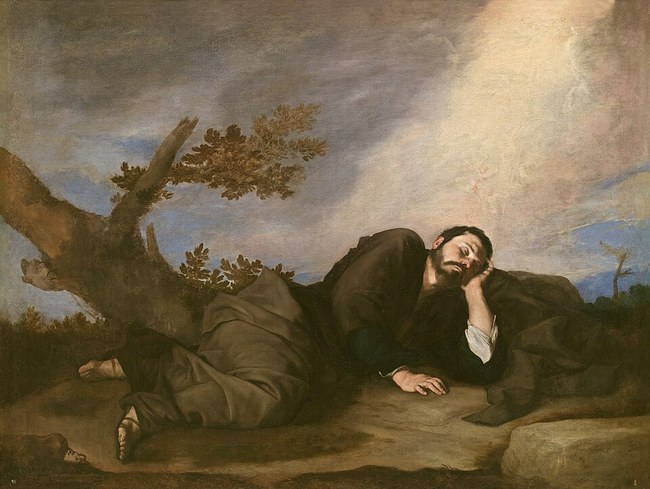
AND YA’AKOV LEFT Be’er Sheva, and he went to Charan. For about 60 years, Ya’akov had been living the dream, sitting and learning in the pure tents of Torah undistracted by the outside world. Now, at the age of 63, it was time to deal with the nightmare that would be Eisav, Lavan, Shechem, and Pharaoh for 67 years, including 22 years of mourning over the mysterious disappearance of Yosef.
Maybe that is why he had the dream of the ladder. He needed the good news to keep him on track through all the troubles he was about to face. He had to know the endgame to survive the “game” itself. Like a baby who leaves the quiet and safety of its mother’s womb for the chaotic world outside of it, Ya’akov was forced to “go out” from his otherworldly reality of Torah for the chaotic one beyond its protective doors.
Why? We are told that our Torah learning is music to God’s ears. Nothing pleases Him more than the mitzvos we do, especially with the proper intention and care of execution. It’s hard enough to convince people who don’t already to live that way. Why shlepp someone who does away from it and make them expend energy fighting opposing forces?
Most people probably already know the answer. They may not like it, but they know it. Chazal say, “According to the effort is the reward” (Pirkei Avos 5:23). They also say, “God wants the heart” (Sanhedrin 106b). Dovid HaMelech put it this way: “The sacrifices of God are a broken spirit” (Tehillim 50:19). All of this addresses the issue head on: Torah and mitzvos are great. Torah and mitzvos with Mesiras Nefesh—self-sacrifice—is greater.
There have been commercials made that exaggerate how far a person will go to satisfy their urge for some materialistic pleasure. The message whether subtle or blatant says: This is so good that people will go to extremes to enjoy it. Shouldn’t you go at least some of that distance? Learning Torah and doing mitzvos when it is less than convenient to do so just shows how important they are to you, a tremendous Kiddush Hashem.
But there is more to that story. History is horizontal for us, but it is vertical for God’s light. It started off at the “top” and has been moving downward through time, weakening as it descends but also appearing in places and ways it didn’t before. The light itself never weakens. It can’t. It’s Ohr Ain Sof, the infinite light of God. But, it picks up “clothing” as it descends, like a person who puts on additional clothing as they reach colder weather. The person remains the same on the inside, but it becomes harder to recognize them on the outside.
But even if the person shows up bundled from head to toe and leaves nothing of their original self visible, the moment they speak they become instantly recognizable. Their voice comes from the inside and breaks through all the layers of clothing over the body from which it emanates, allowing others to look past the physical reality into the spiritual one.
The same is true of God’s light. All that world we see around us that has so much more evil and impurity associated with it is just clothing for that light. Hard to believe, right? I mean, how can something as holy as the Ohr Ain Sof wear such impure “clothing”? You mean like Ya’akov dressing up as Eisav to “sneak” the blessings from his father?
Even though the skin Ya’akov wore was apparently from the Garden of Eden, which Yitzchak acknowledged when he said, “The fragrance of my son is like the fragrance of a field, which God has blessed!” (Bereishis 27:27), still they belonged to Eisav at the time. But the real “clothing” Ya’akov put on was deceit, the complete opposite of how the Torah portrays him. Did the end really justify the means?
When it is being done for the sake of God, and not for personal benefit, and even then you have to get an objective opinion on it. Had Rivkah not insisted on Ya’akov following her plan, he wouldn’t have done it on his own. At least when he “bought” the birthright from Eisav, Eisav knew what he was selling and to whom.
The main point here is that “vayaitzai” refers to more than just leaving town. It refers to Ya’akov’s spiritual departure from the high level of quiet Torah learning to the lower level of people such as Eisav, Lavan, and Shechem. They were the spiritual darkness of Creation, and Ya’akov interacting with them was the Divine light trying to illuminate it. But, to do that, he had donned clothing of this world. It was a sacrifice on his part, but a necessary one to fulfill the greater plan of God’s big picture for Creation.
Latest books published: Derech Eretz, about how “good manners” is a lot more important to world rectification than people think, and Chanukah Forever, my latest effort to better understand the depth and centrality of the holiday of Chanukah. Both are available through Amazon, and anyone interested in making a dedication in either book can still do it. Write to [email protected].
Have a great Shabbos,
Pinchas Winston