



These divrei Torah were adapted from the hashkafa portion of Rabbi Yissocher Frand’s Commuter Chavrusah Series on the weekly portion: ##1387 – May A Kohain Attend the Funeral of the Gadol HaDor. Good Shabbos!
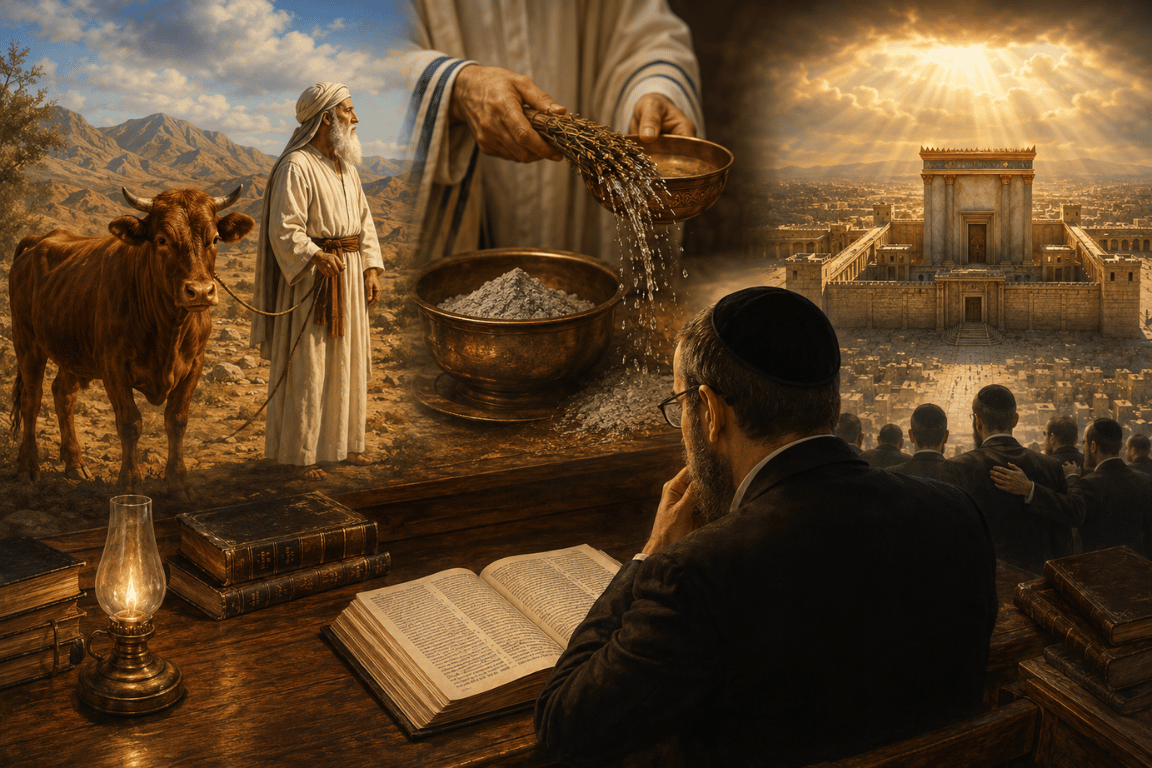
The pasuk at the beginning of Parshas Chukas says “…asher lo alah aleha ol” (that did not go up on it, a yoke). Parshas Chukas begins with the narrative of the laws of the Parah Aduma (Red Heifer). When a person comes into contact with a dead body – even by being in the same room with a dead body – the person incurs tumas mes, a form of ritual impurity due to contact with a human corpse. The only way to remove this form of tumah is by being sprinkled by a kohen with water into which the ashes of the Parah Aduma were mixed.
The Torah refers to this as a ‘chok.’ At the beginning of the parsha, Rashi explains (based on the Medrash Rabba) that “since the Satan and the nations of the world mock Yisrael saying, ‘What kind of mitzva is this? What reason does it have?’ That is why this is called a ‘chok’ – a decree from before Me, which you have no permission to question.”
The Medrash Rabba is actually a little more explicit than Rashi. The Medrash emphasizes the paradox of the fact that the Parah Aduma, whose function is to grant purification to someone who is tameh, also brings tumah to those who are tahor who handle it. Thus, although there are many ‘chukim’ in the Torah (mitzvos whose reasons are not revealed to us), the unique thing about Parah Aduma is that it is the ultimate paradox.
So, while we find sefarim that give reasons for mitzvos such as shatnez (forbidden mixtures), and chazir (the prohibition of eating pig and other non-kosher animals), Parah Aduma remains uniquely inexplicable. How is it that the very thing which purifies also contaminates? In fact, in another place in the Medrash, Chazal quote the pasuk spoken by the wisest man who ever lived “Kol zo nisisi b’chochmah; amarti echkomoh, v’hee rechokah mimenni.” (Koheles 7:23) Shlomo Hamelech is confessing here that despite his wisdom, understanding of the concept of Parah Aduma remained far beyond him. “I figured out everything else – but despite my efforts, the understanding of the Parah Aduma remains far beyond my grasp.”
On the other hand, the Medrash says that the Ribono shel Olam did explain the inexplicable paradox of the Parah Aduma to Moshe Rabbeinu. The Medrash concludes, however, that in the distant future, the Ribono shel Olam will explain Parah Aduma to everyone.
There are several questions:
- If Parah Aduma has a reason and, in fact, Moshe Rabbeinu knew the reason and, in fact, in the distant future, we will all learn the reason, why did the Ribono shel Olam keep this hidden from us?
- Rashi uses the expression that the nations of the world tease Yisrael about this mitzva. They make fun of us, asking how can you say that the very substance used to purify makes the people who handle it impure? The Ribono shel Olam doesn’t want us to become the laughingstock of the nations. On the contrary, the Torah is to be seen as our source of wisdom in the eyes of all the nations (Devarim 4:6).
- The language of the Medrash is “A chok I have legislated; a gezeira I have decreed; do not question it.” The first two expressions of this statement are redundant. Either “I have legislated a chok” or “I have decreed a gezeira” would be sufficient. Why are both statements necessary?
I saw a beautiful pshat in the sefer Be’er Yosef from Rav Yosef Salant. He wants to suggest as follows: We need to realize that Parah Aduma was not some type of obscure thing that people did not need to deal with. In the course of people’s lives, it is inevitably necessary to deal with the effects of death of those around them. Every time someone went to a funeral, he needed the Parah Aduma. Anytime someone came into physical contact with a mes, he becomes a tameh mes himself. In the course of the average person’s lifetime, he will contact tumas mes many, many times. If a person became tameh on a hundred different occasions, he would theoretically need to be sprinkled by the Parah Aduma ash-water mixture a hundred times! Each of those times, the Kohen who does the sprinkling would himself become tameh.
As the Rambam writes (in his Mishna commentary), when a person does something over and over and over again, it makes an impression. Thus, in the course of a Jew’s lifetime, when he encountered Parah Aduma dozens if not hundreds of times, this message (“metaher es ha’temayim u’metameh es ha’tehroim“) was pounded into his psyche. Why?
The Ribono shel Olam is teaching us an invaluable lesson in life that goes far beyond the confines of Parah Aduma. Namely, there are things in this world that do not make any sense. In the course of our lifetimes, we run into situations that are entirely inexplicable. Perhaps the greatest example of this is “Tzadik v’rah lo; Rasha v’tov lo” (Why the righteous suffer and why the wicked prosper). If, Heaven forbid, we need to confront the death of a young person, the death of a child, we cannot figure it out! What does the Ribono shel Olam want?
The answer is that we don’t know those things, and we will never figure them out – at least not in this world, at least not until Messianic times. That is the lesson that the Ribono shel Olam wants us to learn from Parah Aduma. That is why He withheld the reason from us. He wants us to have real-life experience with the phenomenon that there are things that you cannot understand, no matter how smart you are.
Finally, Rav Yosef Salant says a beautiful diyuk in the Rabbinic expression “Chuka chakakti; gezeira gazarti.” Chuka chakakti means I made this chok called Parah Aduma. Gezeira gazarti is the idea of seeing gezeiros that happen in our community and in Klal Yisrael. We are at least familiar with the concept of gezeira.
We ask, “Why did this person die?” “Why is this happening?” It is a Heavenly decree. That is exactly what Chazal are alluding to. The Torah wants us to learn the lesson of Parah Aduma and to extrapolate the lesson, not only to the halachos of tumah and tahara, but also to the paradox of life and the incomprehensible things that we may, from time to time, unfortunately observe in life.
Transcribed by David Twersky; Jerusalem [email protected]
Edited by Dovid Hoffman; Baltimore, MD [email protected]
This week’s write-up is adapted from the hashkafa portion of Rabbi Yissochar Frand’s Commuter Chavrusah Series on the weekly Torah portion. A listing of the halachic portions for Parshas Chukas is provided below:
- #018 – Rending Garments on Seeing Yerushalayim
- #063 – Intermarriage
- #107 – Rabbonim and Roshei Yeshiva — Do Sons Inherit?
- #152 – Halachic Considerations of Transplanted Organs
- #199 – Stam Yeinam: Non Kosher Wines
- #245 – Skin Grafts
- #335 – Postponing a Funeral
- #379 – The Jewish “Shabbos Goy”
- #423 – Tefilah of a Tzadik for a Choleh
- #467 – Detached Limbs and Tumah
- #511 – Autopsies and Insurance
- #555 – Women Fasting on 17th of Tamuz, Tisha B’Av and Yom Kippur
- #599 – Blended Whiskey
- #643 – Choshed Bekesherim and Daan L’kaf Z’chus
- #687 – Water, Coffee and Tea
- #731 – Shkia – 7:02: Mincha 7:00 A Problem?
- #775 – Wine At a Shul Kiddush
- #819 – Mayim Geluyim – Uncovered Water – Is There a Problem
- #863 – Shabbos In The Good ‘Ol Summertime
- #907 – Bracha Acharono on Coffee and Ice Cream
- #951 – The Body Works Exhibit
- #994 – Bilam and His Donkey: A Problem with Tzar Ba’alei Chaim?
- #1038 – Flowers At The Cemetery?
- #1082 – Should You Buy An Expensive Esrog Box?
- #1125 – Saying Kaddish For More Than One Person; Lo’aig Le’rash for Women?
- #1167 – “If Hashem Saves Me, I Make A Neder to…….” Good Idea or Not?
- #1210 – Postponing A Funeral Revisited
- #1255 – I keep 72 Minutes, You Keep 45 — Can I Drive Home With You After 45 Minutes?
- #1256 – The Last Day of Sheva Brachos Starting Before Sh’kia, Bentching After Tzais — Are There Sheva Brachos? And other such Shailos.
- #1299 – Can You Remove Your Yarmulka for a Job Interview?
- #1343 – Making a Mi’she’bairach for a Choleh on Shabbos – Is It Permitted?
- #1387 – May A Kohain Attend the Funeral of the Gadol HaDor
- #1431 – Reuven Has Yahrzeit for Father; Shimon Has Yahrzeit for Mother -Who Gets Maftir?
- #1475 – Can You Pay Someone to be a Shomer for a Mais? – Can You Use a Used Matzeiva?
- #1519 – What Does Hashem Prefer: Small Miracles or Big Miracles?
- #1561 – Does the Torah Care About Your Money?
- #1603 – Can You Use a Plastic Cup for Netilas Yadayim and Kiddush
A complete catalogue can be ordered from the Yad Yechiel Institute, PO Box 511, Owings Mills MD 21117-0511. Call (410) 358-0416 or e-mail [email protected] or visit http://www.yadyechiel.org/ for further information.