

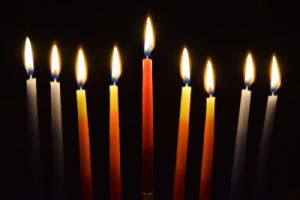
Chanukah
There have been many times that oppressive nations sought to destroy the Jewish people, and we were miraculously saved from their designs. Upon two of these occasions, the Rabbis saw fit to establish an annual holiday commemorating the miraculous salvation, providing us with an opportunity to remember Hashem’s kindness to us, and thank him for saving us. These holidays are Purim and Hannuka.
The Shulchan Aruch, in describing how Hannuka is observed, notes that although it is permissible, and has even become customary, to have a festive meal in honor of Hannuka, this custom is not part of the observance of Hannuka, as originally ordained by the Rabbis. Instead, Hannuka is observed in a more spiritual way, with expressions of thanks and praise of Hashem. This is in contrast to the holiday of Purim, when a meal, and the exchange of gifts of food are intrinsic to the rabbinically instituted observances of the day.
The Levush (quoted by the Mishna Berurah 670:6), explains this incongruity as follows: Purim commemorates the time that Haman, minister to King Achashverosh, enacted a decree calling for the extermination of the entire Jewish people. Had the Jews agreed to renounce their religious practices, and adopt the customs of the nation amongst which they resided, the murderous Haman would not have been satisfied, and would still have called for annihilation of the Jews. Thus, when Hashem miraculously caused Haman’s fall from power, and the subsequent salvation of the Jews, it was a salvation of their physical beings; their spiritual existence was never in danger. The most appropriate way to express our thanks to Hashem for saving our physical beings is by demonstrating our freedom to enjoy the physical gifts he has provided us with.
The oppressive acts of Antiochus and the Syrian-Greeks, were of a different nature. Had the Jews agreed to abandon their own customs and beliefs, and become integrated into the Greek lifestyle, they would have been left alone. Their oppressors sought only to destroy them spiritually. And so, when Hashem granted Mattisyahu and the Hasmoneans victory over the Syrian-Greeks, he was preserving the spirituality of the Jewish nation. Our appreciation for this gift, the opportunity to serve Hashem and recognize him as our G-d, is best acknowledged through spiritual expressions of Hashem’s praise.
All of our holiday-related activities on Hannuka should carry this significance with it. We should take the opportunities we are granted to praise Hashem and re-affirm our committment to Him. Indeed, as we see by Purim, even a meal, a normally mundane activity, can take on a new meaning when done with the proper intentions and thoughts. While our observance on Hannuka is mainly of a spiritual nature, we should let this holiday and all oberservances connected with it, whether physical or spiritual, be a point of inspiration to carry us through until we reach the next holiday which celebrates our physical salvation – Purim.
For questions, comments, and topic requests, please write to Rabbi Yehudah Prero.