

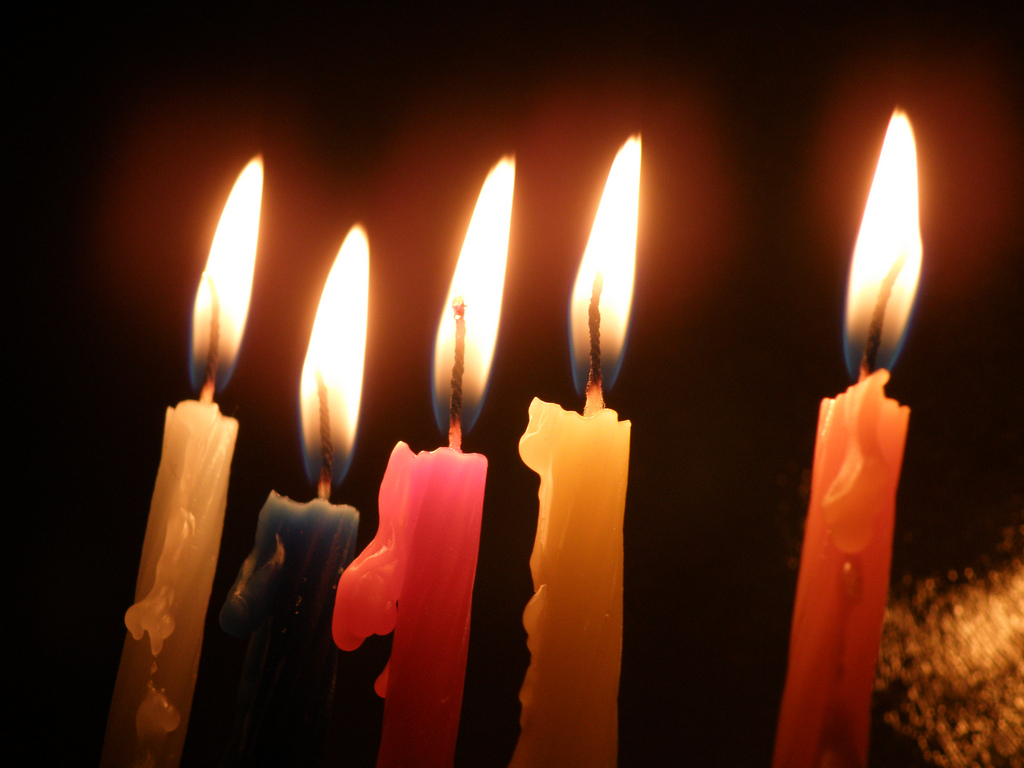
Chanukah
The Lighting of the Menorah
As mentioned in #57, one of the miracles of Chanukah occurred through the lighting of the Menorah. We therefore light a Menorah to remind us of this great miracle. Our sages have written that “All who are careful with the lighting of the Menorah will merit having sons who will be Torah scholars.
The performance of this Mitzvah on the most basic level involves the head of each household, who is to light one light for the entire household each night. A more preferable form of performance is that everyone in the household should light one light each night of Chanukah. The most preferable form, the Talmud tells us, is that the head of the household should light one light the first night, and on each additional night, one light should be added. The purpose of this is twofold: we add to the holiness of the lights by increasing their number, and by having the lights correspond to the number of days, we increase the publicity and awareness about the miracle of Chanukah.
A question is raised about the performance of this mitzvah. By all other performances, the obligation to perform the commandment is on the individual: Each person needs to take the Four Species on Sukkos, and eat Matzo on Pesach. However, on Chanukah the obligation is on the head of each household, and not on all individuals. Why is there this difference? The answer lies in what the reason is behind why we light the Chanukah Menorah. The main reason why we light the Menorah is so we can publicize the great miracle that occurred on Chanukah. This goal can be accomplished by having only the head of each household lighting the Menorah. Once a Menorah is lit in each household, and all members of the household observe these lights, there is no longer any need for anyone else to light, and therefore there is no obligation for anyone else to do so.
Foods Associated With Chanukah
There is a custom to eat dairy products and cheese on Chanukah. This custom stems from the heroism of Yehudis, of the Chashmonean family. Yehudis, a beautiful women, was taken by the leader of the Greek troops. While she was with the Greek officer, Yehudis fed him a dish cooked with cheese so he would become thirsty. Once he became thirsty, she gave him wine to drink so he would become drowsy. When he fell asleep, she took his sword and beheaded him. She then carried his head back to Jerusalem and displayed it, so that the Greek troops would become demoralized. Her plan worked, and the troops retreated.
There is a custom as well to eat foods cooked in oil. The reason for this custom is because by eating these foods, we are reminded of the miracle that occurred with the oil. Two of the most common foods associated with this custom are “Latkes”, potato pancakes and “Sufganiot,” which are doughnuts (or flour pancakes), both of which are fried in oil.
The Draidel – The Chanukah Top
On Chanukah, there is a custom to play with a four-sided top. (For the roots of this custom, look in the Special Edition, which you will be getting soon). There is an interesting contrast between the Draidel and the Gragger, the noisemaker used on the holiday of Purim. Both of them operate through spinning a handle. The Gragger, which has the handle on the bottom of the toy, signifies that an outpouring of prayer from below caused an uproar in the heavens above which averted the decree of destruction against the Jews. The Gragger signifies this by being a toy which is spun by us on the bottom, and makes noise up on top. On Chanukah, G-d in heaven saved the Jews out of His mercy, even though the nation of Israel had not properly repented. We therefore have a toy which we spin from the top to show that the victory occurred only because of the One above, not because we below did anything to merit the salvation.
Check out all of the posts on Elul and Rosh HaShana. Head over to http://www.torah.org/learning/yomtov/ to access the YomTov Page. Then click on the icon for the holiday of your choice.
For questions, comments, and topic requests, please write to Rabbi Yehudah Prero.