

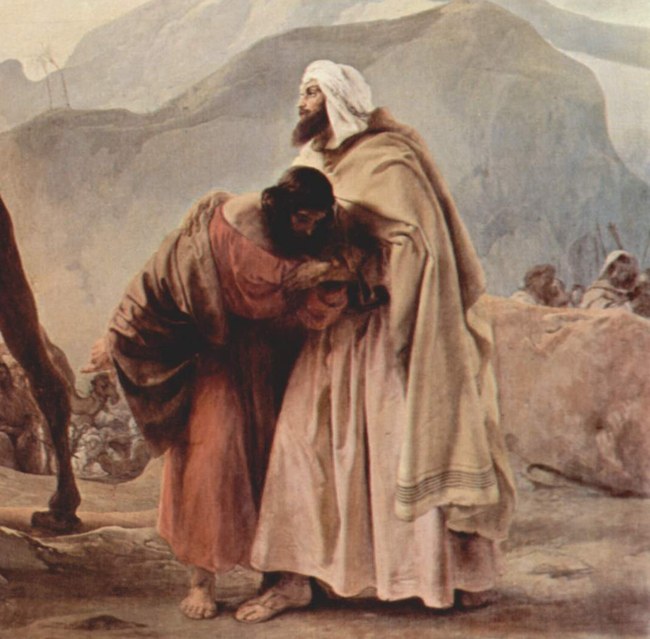
YA’AKOV SAID WHEN he saw them, “This is the camp of God,” and he named the place Machanaim. There are about 1.8 million words in the Talmud Bavli (Babylonian Talmud) and about half that in the Talmud Yerushalmi (Jerusalem Talmud). There is, of course, a lot of overlap since they are both based upon the same mishnayos, and many of the same rabbis are quoted in both.
There are also some obvious differences. There are more stories in the Bavli (Aggadata), but more tractates in the Yerushalmi which, being from Eretz Yisroel, addresses many of the agricultural laws that are not relevant in the Diaspora. But one such difference between the two bodies of Talmud is very subtle—only one word actually—and took the genius of the Rogatchover (HaGaon Rav Yosef Rosen, zt”l, 1858 – 1936) to point it out.
The Gemara says in the Bavli:
The Rabbis taught: The early chassidim would wait one hour, pray one hour, then wait one hour again. Since they would spend nine hours per day in prayer, how was their Torah preserved? And how was their work accomplished? Rather, because they were pious, their Torah was preserved and their work was blessed. (Brochos 32b)
In other words, because the Chassidei Rishonim had their merit-worthy approach to tefillah, miracles happened for them. God made sure that their devotion in prayer did not come at the cost of what they had already learned, even if naturally they should have forgotten it. Furthermore, the Gemara adds, when they did work, they earned more than was otherwise the case for people less pious. This alone is an important message about parnassah and bitachon and emunah, echoed elsewhere in the Gemara (Brochos 6b).
This section of Gemara is also mentioned in the Yerushalmi, but with a world of difference. Everything is basically the same except for one thing. In answer to the Gemara’s question, “How was their Torah preserved?” It does not say, “because they were pious their Torah was preserved,” but that, like their parnassah, it was blessed.
Not only did the Rogatchover notice and point this out, but, in classic Rogatchover style, he used it to brilliantly explain something seemingly completely unrelated, the difference between Mordechai and his colleagues in the Purim story. But that’s a different “parsha.”
Basically, the Rogatchover said, the two sections subtly show the difference between living in Eretz Yisroel and Chutz L’Aretz, the Diaspora, where the Rogatchover lived (Belarus) and died (Vienna). When it comes to parnassah, apparently, there is no difference between Eretz Yisroel and Chutz L’Aretz. If you devote yourself to prayer in either place, God will make you more successful financially than you naturally should be. Your work and money will be “blessed,” meaning that it will supernaturally increase even if no one sees it happening.
But, said the Rogatchover, it is not true of Torah. Sacrificing business hours for prayer will result in a miracle in either place, but the extent of that miracle differs depending upon if you are in Eretz Yisroel or “Chul” (Chutz L’Aretz). Outside of Eretz Yisroel, the best you can hope for is that you won’t lose what you have already learned. But, inside Eretz HaKodesh, even your learning will be “blessed,” meaning that you will end up with more Torah learning than you actually learned.
Having said that, we can now better understand the Torah’s narrative over the last two parshios. In Parashas Toldos, Ya’akov was described as “an innocent man, dwelling in tents” (Bereishis 25:27). That is the way he remained until the end of the parsha when he took the brochos of Eisav and made him murderously angry. He did hide for 14 years in the yeshivah of Shem and Eiver to learn while still in Eretz Yisroel, but then he left for Padan Aram in Mesopotamia to take refuge from his brother and marry his future wife.
That’s where he stayed for the next 20 years. Reporting on that, the Torah only speaks about the miracles that happened for him regarding his parnassah. We hear nothing about any Torah learning he accomplished during that time, and by the sound of it, he didn’t have very much time to learn. But, his 20 years are up by the end of the parsha, and just before it ends he re-enters Eretz Yisroel, the land of “blessed” Torah, as the verse above recounts.
Perhaps that is why when Ya’akov prepares for his confrontation with Eisav, he tells him that he kept all 613 mitzvos while living with Lavan, as if that is a chiddush, something unexpected. It was. Twenty years in the Diaspora and living with Lavan should have spiritually worn him down. The only reason why it didn’t was because God “preserved” his Torah while fulfilling the wishes of his parents (tefillah is not the only reason for Divine protection and blessing).
But, Ya’akov couldn’t really tell Eisav about supernatural advancement in learning while outside the land because there wasn’t any to speak of, just blessings in parnassah, which he shows Eisav as well with his gifts and accounting. As the Gemara says, even the air of Eretz Yisroel makes a person wise (Bava Basra 158b), and after 20 years of hard work in the business, Ya’akov Avinu was looking once again to retire and learn full time in kollel.
But, as we find out in next week’s parsha, blessed learning and parnassah is for this world. Full-time tranquility, well, that’s a matter for the World to Come.
Latest books published: Derech Eretz, about how “good manners” is a lot more important to world rectification than people think, Chanukah Forever, an even deeper look at the roots of Chanukah, and now, Only Way Out: How the Holiday of Purim Changed Everything. All are available through Amazon. Book dedications possible by writing to [email protected].
Have a great Shabbos,
Pinchas Winston