

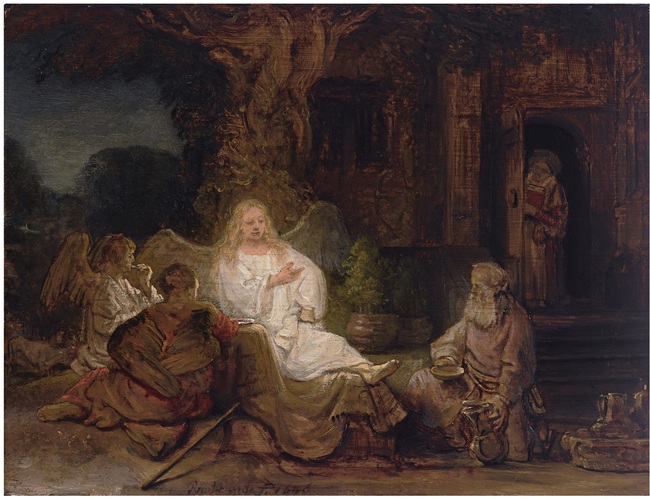
And Avraham rushed to the tent to Sarah, and he said, “Hurry, three seah of meal, fine flour; knead and make cakes.” And to the cattle Avraham ran, and he took a calf, tender and good, and he gave it to (HaNaar) the youth, and he hurried to prepare it. (Brieshis 18:6-7)
to the youth. This was Ishmael, (l’chancho) to train him to perform Mitzvos. — Rashi
Here we have an open window to gain and glimpse of Avraham Avinu’s pedagogical methodologies. This is the first example in the Torah of a father educating his child. Let us look closely and take notes. Guests have just unexpectedly arrived and Avraham rushes to the tent of Sarah, places his order and declares, “Hurry!” Then he runs to the cattle, chooses a tender and good specimen, and delivers it to “HaNaar” – the youth. Rashi tells us that this is Yishmael and Avraham is educating him by including him in the Mitzvah of HaChanasas Orchim, taking care of the needs of guests, and he hurries to do it! It’s peculiar that here Avraham gives no verbal instruction. Conspicuously absent is an overt mandate to “hurry up!” That speaks volumes.
We can ask, “How did Yishmael know to hurry, without being told?” The answer could be that Avraham ran to greet the guests, and he rushed to Sara’s tent and ran to the cattle, and delivered it to the boy. Avraham himself was moving with rapidity. He was on fire with genuine enthusiasm and enthusiasm is contagious. How could the Naar do any different? He needed no external force to move him into quick action. Avraham was the ideal role model, a messenger perfectly congruent with his message. This is how he educated his child to do the Mitzvah and to do it with a sense of ecstatic urgency.
We can wonder why he needed to tell Sara to hurry? I will admit that I am not entirely certain, but one thing is for sure. Avraham was not asking anybody else to do what he himself was not already doing. That is what we call “leadership by example”.
One Erev Shabbos I was sitting in the living room, learning and barking commands to my children, “Somebody please wash those dishes in the Milchig sink! Who can I get to set the table!? I thought I was doing good until my wife gently approached me and inquired, “What are you doing?” I told her, “I am practicing leadership! Delegation is the key to leadership!” This was a teachable moment. My wife volleyed back, “And leadership is the key to delegation!” Suddenly, I’m at the Milchig sink. It’s easier to get others to do when you are also doing.
I have had parents try to impress me by telling me, “Rabbi I push my kids!” They look up at me for an affirming reaction, but I tell them, “Don’t push! Pull!” The truth is not to even pull. Nothing good is accomplished with force or pressure. It should rather be a pleasure and not a pressure. I ask them, “When a car honks its horn behind you, does it inspire you to want to drive faster or slower?” Nobody likes to be told what to do. It builds resistance and avoidance. That’s not the flavor of Mitzvos that creates an enduring attachment. When a car passes quickly on the highway, we all tend to speed up a little. When a parent is happily excelling in davening and learning it naturally and easily invites the children to want to do the same and better.
The first father and son dialogue is found on the way to the Akeida. It is stated twice, “VaYeilchu Shneihem Yachdav” – “And they walked together. Once was in praise of Avraham who was keeping pace with Yitzchok who was unaware at that time of the destination and goal. The second time is to highlight the greatness of Yitzchok who keeps up with Avraham after learning about his possible fate.
Rav Hirsch points out that there is no generation gap when parents and children have the same goal, to do the Ratzon HASHEM, the will of The Creator. Each one is setting the pace and standard for the other, even though Avraham and Yitzchok had completely different approaches to Avodas HASHEM. Avraham dwelled in a world of utter kindness and Yitzchok was an intense student of a universe that can’t be seen. Yet, living from their example, we continue to keep pace with each other, parents with children on a journey together forever.