

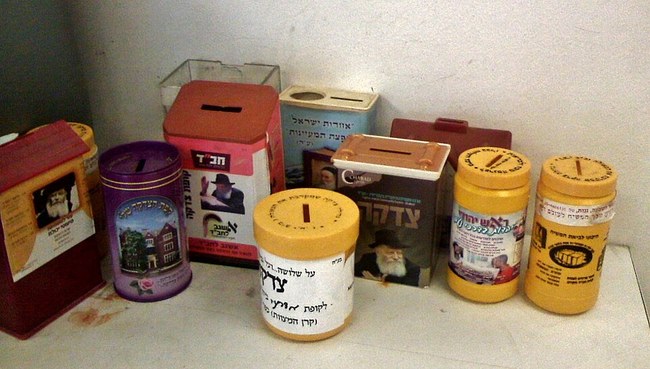
Yaakov made a neder to give ma’aser – a tenth – from his income. We’ve come across this idea earlier. When Avraham met Malkitzedek, he gave him a tenth. Rashi says that Avraham gave a tenth to Malkitzedek, who was Kohein. Others say that Malkitzedek gave the tenth to Avraham, because Malkitzedek was forced to relinquish his role as Kohein to Avraham. (1)
There are other kinds of ma’aser. There is an obligation to give a tenth of the produce of Eretz Yisrael.
Eisav had tried to convince his father Yitzchak of his concern for mitzvos. Eisav asked, “How does one take ma’aser from salt and straw?” Many take this as a foolish question. Salt and straw are not produce that need to be tithed.
Rav Moshe Shternbuch, however (2), explained it as an intelligent question. Eisav wasn’t asking about produce, rather he was asking regarding income. As he had acquired salt and straw, the question was — should he take off a tenth, or be more stringent (as some are), and remove a fifth? And Yitzchak would be impressed with the intelligence and diligence of his older son.
Giving Thanks
“There was no one who gave thanks until Leah came and said, ‘This time I thank Hashem!’” (Brochos 7b) The commentaries question: we find thanks before Leah. Noach praised Hashem, as did Avraham and Eliezer. What was unique about Leah’s thanks? Rashi explains that the matriarchs knew that Yaakov was destined to have twelve sons. Since there were four wives, each should have only three. When Leah bore a fourth son, she gave thanks that she now had more than she deserved. This is the essence of true thanks, to realize that we don’t deserve what we are given.
The child was called Yehuda (29:35) from the root of hodaah — giving thanks. He would be the ancestor of Dovid Hamelech, who sang so many praises to Hashem. (The word ‘Jew’ comes from Yehuda — we are the people who give thanks.)
Modim D’rabanan
When the Chazon says the brocha of ‘Modim’ the tzibur says another version called ‘Modim D’rabanan’. Rav Shmuel Kaminetzy, at an Aguda convention, addressed what a previous speaker had said: “The tzibur must say their own thanks, because thanks cannot be said through an agent.” Rav Shmuel said this is not sufficient. The Rabbis are telling us — when we hear thanks, we must all say thanks!
An amazing point about Modim D’rabanan: it concludes that we thank you for letting us thank you! This is what it means to be a Jew — to realize we have more than we deserve.
—————————————————
1. Because Malkitzedek praised Avraham before praising Hashem, he lost the right to the Kehuna. This is a great lesson for us — not to be impressed with people and technology before giving credit to the One and Only Hashem.
2. Chochma V’da’as
Photo Credit: An assortment of tzedakah boxes, by Eliran t with CC BY-SA 4.0 license, on Wikimedia Commons.
