

ONLY 21 DAYS until Chanukah, b”H. I’m not exactly sure why but, of all the chagim, Chanukah speaks to me the most. Every year I feel an “obligation” to write another book about the holiday, going deeper than the previous ones. Someone recently told me that they nicknamed me the “Chanukah Rabbi” because I write about it so much. I’m inspired.
This year’s version, in case you did not see the note at the end of last week’s Perceptions, is called, “Chanukah Forever: The Awesomely Eternal Reality of Chanukah.” It’s not just me writing about Chanukah in more depth. It is me sharing my personal journey into the depth of Chanukah. I write organically, so even I am surprised by some of things that show up on paper in the end.
The point of the book is nothing new. It shows how Chanukah, like Purim, though only a rabbinic holiday has serious Torah roots. What is new in this book is that some of those roots are not so obvious, or what they lead to. It’s what you find when you follow Ben Bag Bag’s advice in Pirkei Avos:
Turn the Torah over and over for everything is in it. Look into it, grow old and worn over it, and never move away from it, for you will find no better portion than it. (Pirkei Avos 5:26)
This is, after all, what Chanukah is all about. The soul of Chanukah is the Ohr HaGanuz. The soul of everything is the Ohr HaGanuz, because God made Creation with it. But there is something specifically about Chanukah that draws our attention to this, more than Purim or even all the Torah chagim. I address all of that in my new book.
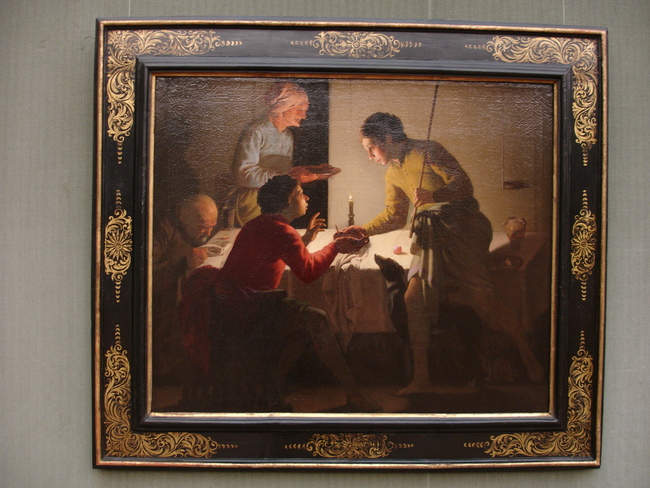
For now, I just want to point out how ultimately, this was the difference between Ya’akov and Eisav in this week’s parsha. Ya’akov lives inside the tents of Torah while Eisav was a man of the world. Their worlds met head-on when Eisav came home close to death and demanded Ya’akov feed him. Ya’akov, seeing Eisav for what he was, used the opportunity to distance Eisav from the future Jewish People by “selling” Eisav his food for Eisav’s birthright.
But, it didn’t happen without any discussion:
Eisav replied, “I am going to die; so why do I need this birthright?” (Bereishis 25:32)
Eisav asked [Ya’akov], “What is the nature of this service?” He replied, “There are many prohibitions and punishments and death penalties involved with it”… He (Eisav) said, “I am going to die because of it (i.e., the birthright); if so, why should I want it?” (Rashi)
But then the Torah adds something that really seems superfluous here:
And Ya’akov gave Eisav bread and a pottage of lentils, and he ate and drank and arose and left, and Eisav despised the birthright. (Bereishis 25:34)
Despised the birthright? Why? Ya’akov freed him of it, took the responsibility off of his shoulders. If he had to feel anything at that time, should it not have been relief?
It is reminiscent of the Amnon and Tamar episode. Amnon was so lovesick for Tamar that he feigned sickness to trap her and force his way with her. But, it says, after he did his terrible deed, he didn’t just reject Tamar, but “his hate for her was greater than the love he had for her” (II Shmuel 13).
We can understand that after Amnon “conquered” Tamar than his infatuation ended. That’s how infatuation works. But despise her more than he originally “loved” her? How does that work?
Because, Amnon knew that he had done a very lowly thing, that he had disgraced himself acting the way he had. At that point, he had a choice to do teshuvah and try and make amends somewhat, like marrying Tamar as she begged him knowing her chances of marrying another were slim. Or, he could defend himself and make her the bad person. The navi tells us which path he chose, and it cost him his life after Tamar’s brother avenged his sister by killing Amnon.
Likewise, Eisav, after selling the birthright knew inside that he had given up something important, and it made him feel bad about himself. So, rather than regret his actions and try to rectify what he had done, he chose to defend himself and blame the birthright for the way he felt. He projected his self-disgust onto the birthright instead.
What’s so Chanukah-ish about that? The Bnei Yissachar says that the Ohr HaGanuz is inside the 36 candles of Chanukah, but all I ever see is clear olive oil, a wick, and a flame burning from it. But, if you “look” closer with your mind’s eye, you will see a metaphor for what a person should be like. The jar of oil is a person’s body, and the flame is the soul that burns and illuminates from within it.
The message? Be as “clear” as the oil that you can see right through. “Tocho k’boro,” the Gemara calls it, when a person is the same on the inside as on the outside. It’s all about self-honesty, about being in touch with our inner truth and letting that illuminate our world and the world of others. Only then can we truly be who we are and meant to be, which opens the door to a much closer relationship with God and all the benefits that come along with it.
Latest book published: Derech Eretz, about how “good manners” is a lot more important to world rectification than people think, and Chanukah Forever, my latest effort to better understand the depth and centrality of the holiday of Chanukah. Both are available through Amazon, and anyone interesting making a dedication in either book can still do it. Write to [email protected].
Have a great Shabbos,
Pinchas Winston