

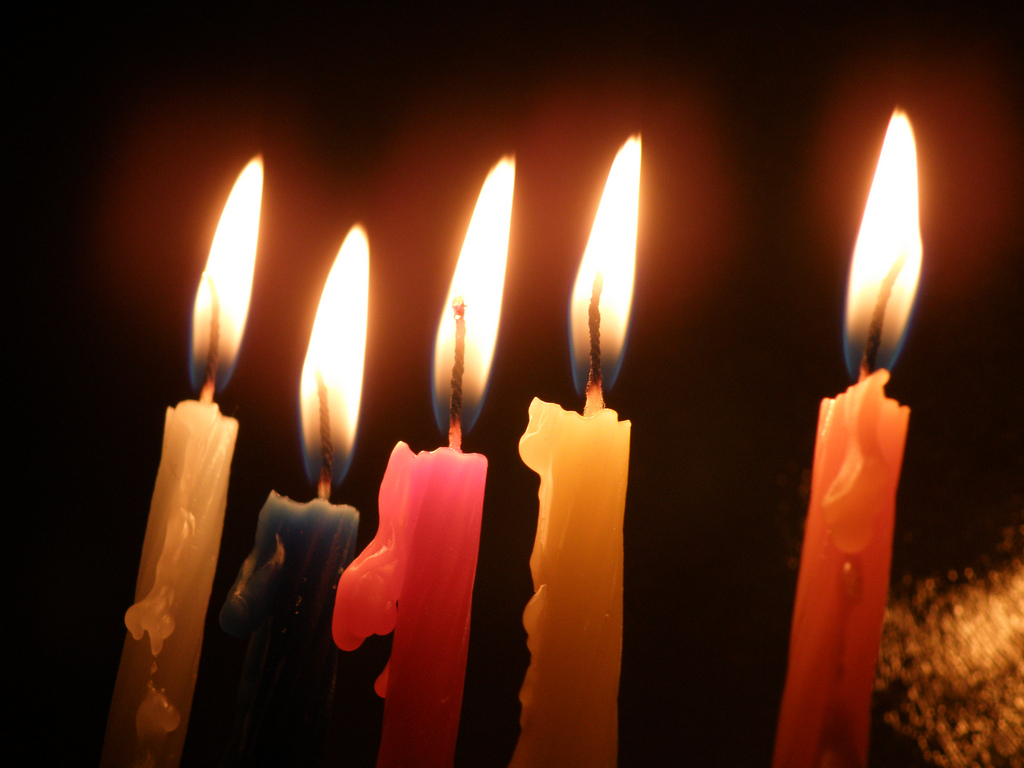
Chanukah
Chanukah begins on the 25th day of the month of Kislev, this year at sunset on December 3, 1999, and lasts eight days. Chanukah is known mainly for the ritual of lighting the Menorah, an eight branched candelabra, in commemoration of the miracle involving a single flask of oil lasting eight days instead of one. (See I:57 for further background information). In addition , Chanukah celebrates the victory of the nation of Israel, led by the Chashmonaim, a family from the tribe of Levi, over the Yevanim, the Syrian-Greeks.
The Talmud (Shabbos 21b) sums up the background of Chanukah: “When the Yevanim entered the Sanctuary of the Holy Temple, they defiled all of the oil there and rendered it ritually impure. When the House of the Chashmonaim strengthened and were then victorious over the Yevanim, they searched and found only one flask of oil that had the seal of the Kohen Gadol (High Priest) in tact, enough to last one day. A miracle occurred and they were able to light with it for eight days. The next year they established and made these days into a holiday, for saying songs of praise and thanks.”
The Maharal (Ner Mitzvah) discusses the history of Chanukah. It appears from the statement of the Talmud that Chanukah was established in commemoration of the miracle of the oil. The Menorah in the Temple was supposed to be lit every day, and thus this consistency was threatened by the lack of pure oil. A miracle occurred, and the one day supply of oil lasted eight days. The Maharal queries about this reason. Generally, we have the obligation to praise and thank G-d when a miracle was performed for us and we were therefore saved from peril and danger. The Sages did not establish a day for praise and thanks because we were given an opportunity to perform a Mitzvah (commandment), even if this opportunity arose via a miracle. However, according to the statement of the Talmud, it appears that is exactly the case by Chanukah. What, the Maharal asks, is the Talmud telling us about the reason underlying the celebration of Chanukah?
Megillas Antiochus, a narration of the story of Chanukah, contains interesting information about the persecution imposed by Antiochus, the leader of the Yevanim. “And it was in the days of Antiochus, the king of Yavan, a great and strong king, with an established kingdom, to whom all other kings listened, that Antiochus conquered many provinces . . . He said to his advisors, ‘ Are you aware that there is the Jewish nation that lives in Jerusalem? To our gods they bring no offerings, our religion they do not practice, and the faith of the king they have cast away to practice their own. They anxiously anticipate the day when my kingdom will be eradicated, and they ask When will our king lead us, and rule over the sea and the dry land , and the whole world will be given to our hands. It is an affront to the kingdom to allow these people to exist on the earth. Now, let us go and put ourselves upon them, and we will annul the covenants which they have established with their G-d, that of the Sabbath, the New Moon, and circumcision.’ These words found favor in the eyes of Antiochus’ officers and infantrymen.”
This ” Megilla” later relates how Antiochus went about his scheme. “And when the word of the king was heard, it happened that they found a man who circumcised his son. They brought this man and his wife and hanged them right next to the boy. They also found a woman who circumcised her son on the eight day, after her husband had died. She went up on to the wall of Jerusalem with her circumcised son in her hands. She said to the officers ‘You think that you will be able to nullify the covenant that we entered into with Him. This covenant of our forefathers will never be abolished, and the commandment of Bris Milah will never depart from our children’s children.’ Her baby son then fell to the ground, and she fell after him, and the two of them perished together. There were many people who acted similarly in those days, and they did not change from the covenant of their fathers.”
The Bris Milah, circumcision, was one of the religious observances that Antiouchus believed was integral to the existence of the nation of Israel. In order to eradicate the practice of Judaism, circumcision had to end. Circumcision, according to the Ramban, was chosen as the sign of the covenant between G-d and the nation of Israel. Just as the body of the male, after circumcision, differs from males of other nations, so to the relationship the nation of Israel has with G-d differs from that of other nations. Eradication of this sign of uniqueness would permit the nation of Israel to be like anyone else, Antiochus’ goal.
The Maharal explains that Antiochus’ goal indeed was to remove the holiness of the nation of Israel, to destroy the Torah. If Antiochus succeeded in preventing people from performing Mitzvos, and the Torah and its dictates were not studied and followed, the nation of Israel would cease to exist. The Holy Temple was central to the religious life of the nation of Israel. After the Chashmonaim defeated the troops of Antiochus, they came to rededicate the Temple. The nation had not allowed their special relationship with G-d to weaken. They kept their identity, and they continued to adhere to the Torah’s precepts. The Temple would now once again be in the proper hands, for proper use. To reestablish this connection with G-d, to resanctify the Temple, the Chashmonaim wanted to light the Menorah. Alas, they only had enough oil to light the Menorah for one day. However, the oil lasted for eight. Our celebration of this miracle is not solely a celebration of being given the opportunity to perform a Mitzvah. It is a celebration of our being able to practice our religion. It is a celebration of our ability to persevere and defeat those who desired our spiritual destruction. Because the nation of Israel maintained its covenant, its unique relationship with G-d, they were able to emerge victorious. They were allowed, through miraculous means, to perform a Mitzvah in the Temple, the bastion of spirituality. When the Talmud says we celebrate the miracle of the oil, it means that we celebrate the fact that we were able to perform that Mitzvah because we were victorious in overcoming the spiritual decimation that threatened our nation.
May the Chanukah lights shine bright!
Check out all of the posts on Chanukah. Head over to http://www.torah.org/learning/yomtov/ to access the YomTov Page. Then click on the icon for the holiday of your choice.
For questions, comments, and topic requests, please write to Rabbi Yehudah Prero.