

Is There a Mitzva to be B’simcha?
Avraham was given tests. He was told to go, and leave behind his elderly father, but wasn’t told where to go. When he came to Eretz Kana’an, and was told that this was the land that would be given to him and his progeny, there was famine; he suddenly had to leave. Still, he didn’t lose faith. Rashi says that he had to borrow along the way, confident that he would repay on the return trip.
The Divrei Yoel writes that the great test was to be b’simcha (1) on his journey, even though traveling involved great hardship. Rav Yoel notes that the Torah gives a severe punishment for not serving Hashem with simcha (Devorim 28:47), yet we do not find a mitzva in the Torah to serve Hashem with simcha (2). There is a rule, mentioned many times in the Gemara, that if you find a punishment, there should be a corresponding commandment! (3)
Even though one who is commanded is greater than one who is not (4), perhaps it is not practical to command something dependent on the heart. Although we have mitzvos to love Hashem and to fear Hashem, these mean to do things that bring love and fear. But if there would be a mitzva of simcha — the yetzer Harah would overcome a person.
From the fact that Hashem wrote the punishment for not serving with simcha, we understand that it is a mitzva to act with joy, but Hashem left it without a clear command in order to reduce the chances of the yetzer Harah overcoming the person.
But Avraham Avinu was told to serve Hashem with joy. He could live up to it.
Avraham Introduces a Name
We’ve discussed many times that Hashem’s name is written in the Torah, but we read it as a different word, pronouncing it as Adnus. Avraham receives special praise that he referred to Hashem as Adnus without blending it with the full name of Hashem (Brochos 7b). He recognized that Adnus, meaning The Master, addresses the hashgacha pratis. Hashem watches over every detail of our lives. This is why Avraham davened for everything — he had found the power of the Master of the world.
Many blame Noach for not praying for mankind, but Hachanas Leiv L’tefila writes that, indeed, he davened for them; he simply did not pray with mesiras nefesh. Avraham had found the secret of the service, the privilege to communicate with the Master of all.
It’s like the plane is taking a steep plunge but you can grab the lever and steady it. When we daven with mesiras nefesh, we are pulling the lever! Steady the plane and the Pilot will take over with steady hands.
Was Avraham the First?
Although the Gemara (Brochos 7b) says that Avraham was the first to use Adnus without blending it with the full name of Hashem, the Medrash seems to contradict this. Bereishis Rabbah (chapter 17:5) states that Adom Harishon gave Hashem the name of Adnus!
In the Teshuvos of the Chasom Sofer (Hashmatos, 192) he writes that — No, that was referring only to the kri, I.e., a substitute reading for Hashem’s Name. Meaning, Adom Harishon’s intention was for the Shem Hashem, but he wouldn’t pronounce it. Instead, he called Hashem Adnus, as we do today. However, to refer to Him simply as Adon Olam, the Master of the World, this was Avraham’s innovation.
————————————-
1.The Divrei Yoel quotes this from Seforim based on the first Rashi, that Avraham was told that leaving would be for his good and his benefit.
2.There are specific verses which command joy, such as to rejoice during the chagim (where there is eating and drinking). Most people would quote Tehilim, where it states “Serve Hashem with joy…”. However, the kapitel is discussing the Korban Todah. The commentaries explain that when one experiences a neis, he must bring the Korban with true joy. We don’t have a clear verse in the Torah commanding service with joy.
3.This is actually said with court cases. Here, the punishments mentioned in Devorim 28:47 are from shomayim. Nonetheless, the logic is compelling; why does Hashem punish in a certain area without having commanded anything about it?
4.If a person acts from his own will, the evil inclination is not as strong as when he is ordered to act.
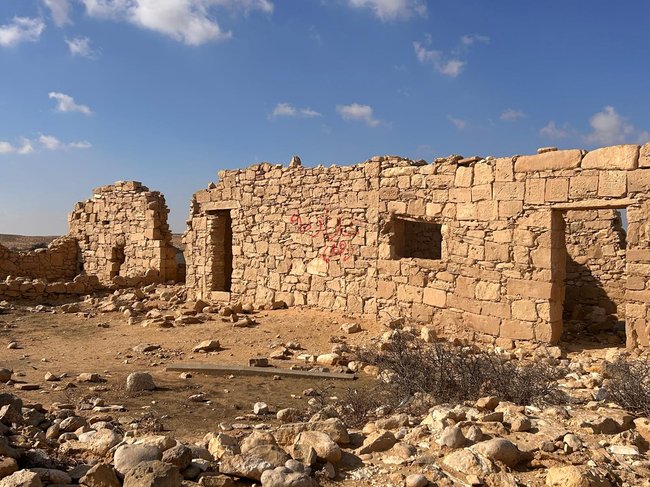
Photo Credit: The Ottoman-period road station at Halutza in the Negev desert, by Idit Herzog with CC BY 2.5 license, on Wikimedia Commons.
