

בס”ד
Volume 41, No. 8
18 Kislev 5787
November 28, 2026
This week, we read of Yaakov’s reunion with Esav. The Torah relates (32:8), “Yaakov became very frightened, and it distressed him.” Rashi z”l explains: “He was frightened that he might be killed, and he was distressed that he might have to kill Acheirim / others.”
R’ Uri Cherki shlita (rabbi and educator in Yerushalayim) explains: Yaakov’s fear of killing Esav arose from his awareness that there was some good in Esav; therefore, Yaakov was reluctant to save himself if it meant taking Esav’s life. Perhaps Rashi alludes to Yaakov’s concern about the good hidden within Esav when he uses the noun “Acheirim,” the same word that the Gemara (Horiyot 13b) uses to refer to the Sage of the Mishnah Rabbi Meir. That sage was a relative of the Roman Caesar Nero, meaning that he, like the Romans in general, was a descendant of Esav. (The fact that Esav could have a descendant such as Rabbi Meir is evidence that there was a spark of goodness within him.)
How did Hashem respond to Yaakov’s reluctance? He sent Esav’s guardian angel to attack Yaakov (32:25), forcing Yaakov to fight whether he wanted to or not. Only after confronting that representative of Esav’s evil did Yaakov deserve to be called “Yisrael” (32:29), and only then was he ready to re-enter and settle in Eretz Yisrael. Notably, after defeating Esav’s guardian angel, Yaakov was even able to hug and kiss Esav (33:4). From a position of strength, Yaakov was allowed to love his nemesis. (Nipagesh Ba’parashah)
********
“Yaakov became very frightened . . . Yaakov said, ‘Elokim of my father Avraham and Elokim of my father Yitzchak, Hashem Who said to me, “Return to your land and to your relatives and I will do good with you.” I have been diminished by all the kindnesses and by all the truth that You have done Your servant; for with my staff I crossed this Jordan and now I have become two camps. Rescue me, please, from the hand of my brother, from the hand of Esav, for I fear him lest he come and strike me down, mother and children’.” (32:8-12)
Hashem had already promised Yaakov (28:14), “Your offspring shall be as the dust of the earth, and you shall spread out powerfully westward, eastward, northward and southward.” Why, then, was Yaakov frightened of what Esav might do to him?
R’ Azariah Figo z”l (1579-1647; Italy) offers a novel explanation: Hashem had, indeed, promised Yaakov that his offspring would be “as the dust of the earth,” but He never said that “all” of Yaakov’s children would multiply so. Perhaps, then, Hashem would allow Esav to destroy all or part of Yaakov’s family, and then Hashem would build the Jewish People from the remainder, or He would give Yaakov a new family. After all, Hashem had rejected some of Avraham and Yitzchak’s children. And, He would later say to Moshe (Shmot 32:10), “Let My anger flare up against them and I will annihilate them, and I will make you a great nation.”
Yaakov was frightened of this potential outcome. He wanted Hashem to protect the children that he already had and to build the Jewish People from all of them. He prayed, in effect: “I already have two whole camps of children; don’t reject them.” This explains why Yaakov appealed here specifically to “‘Elokim of my father Avraham and Elokim of my father Yitzchak.’” He was saying: “Please do not reject my children as You did the children of Avraham and Yitzchak!” (Binah L’ittim: Sukkot #1)
********
“Yaakov was left alone and a man wrestled with him until the break of dawn. . . Therefore, Bnei Yisrael are not to eat the Gid ha’nasheh / displaced sinew on the hip-socket to this day, because he struck Yaakov’s hip-socket on the displaced sinew.” (32:25, 33)
R’ Eliyahu Capsali z”l (1483-1555; Chief Rabbi of Candia, Crete) writes: Part of the Mitzvah of Kibud av v’em / honoring parents is for the son to go everywhere with his elderly parents–not to move from their company or leave them alone, especially when they go out to the markets and the streets when they are “elderly, coming along in days” (borrowing the words of Bereishit 24:1), their strength is waning, and their eyesight is weakened. “In every place that the souls of their feet tread” (paraphrasing Devarim 11:24), their son should be by their side.
R’ Capsali adds: I found support for this in Midrash Pesikta Rabta, which teaches that the reason the Jewish People are forbidden to eat the Gid ha’nasheh is that Yaakov’s sons failed to honor him, letting him go out alone, as a result of which he was injured. (Me’ah She’arim, Sha’ar 17)
********
“He said, ‘No longer will it be said that your name is “Yaakov,” but rather “Yisrael,” for you have wrestled with the Divine and with man and have overcome’.” (32:29)
“Elokim said to him, ‘Your name is “Yaakov.” Your name shall not always be called “Yaakov,” but “Yisrael” shall be your name.’ Thus He called his name ‘Yisrael’.” (35:10)
R’ Avraham Zvi Kluger shlita (Chassidic Mashpia in Bet Shemesh, Israel) notes: Whereas the angel said, “No longer will it be said that your name is ‘Yaakov’,” Hashem said, “Your name is ‘Yaakov’.” This means, the Gemara (Berachot 13a) teaches, that “Yisrael” was not a replacement for “Yaakov”; rather, the Patriarch henceforth would have two names.
R’ Kluger continues: Another difference between what the angel said and what Hashem said is that the former gave a reason for the name “Yisrael,” while the latter did not.
R’ Kluger explains: “Yaakov,” coming from the word meaning “heel,” describes the Jewish People when they are in a low spiritual state. “Yisrael,” having the same Hebrew letters as “Li rosh” / “Mine is the head,” refers to the Jewish People in a more elevated state.
When the angel told Yaakov, in effect, “You are no longer ‘Yaakov’ because you have risen to a high level,” the angel did not intend to praise the Patriarch. Rather, the angel was trying to set him up for disappointment and despair when his descendants would inevitably falter. “You have wrestled with angels, so you are great and will never fall,” the angel was implying, knowing very well that that was not realistic.
Hashem wanted to convey a different message to the Patriarch: Even the “best” people fall sometimes. Your name is still “Yaakov” and it will always remain so, Hashem says. Inevitably, there will be times of failure, times when your descendants will fall from their high level. Nevertheless, know that you are also “Yisrael,” and not because you once wrestled successfully with an angel. You are lofty (‘Yisrael’) in My eyes even without My giving you a reason.
R’ Kluger adds: In light of this we can understand why we say when naming a newborn, “His/her name shall be called in Yisrael [so-and-so].” It is as if we are telling the child: Hashem has already identified you as someone lofty, though you have done nothing yet to earn that title. (La’brit Habeit p.287)
********
Shabbat
We read (Tehilim 68:12), “The Master issued a declaration; they herald a mighty host.” Midrash Tehilim comments: Rabbi Yosé ben Chanina says that just as a person banging a hammer on a rock causing sparks to scatter in all directions, so too the Torah says (Shmot 20:8), “Remember the Shabbat day to sanctify it,” but the Jewish People honor it with food, drink, and clean clothes. Not only that, they welcome Shabbat with Shirim and Zemirot (two words for songs), as it is written (Tehilim 92:1), “Mizmor shir for the Shabbat day.” [Until here from the Midrash]
R’ Eliezer Ben-Zion Brok z”l (1904-1985; founder and Rosh Yeshiva of the Novardok-Bet Yosef Yeshiva in Yerushalayim) explains: The Midrash is commenting on the fact that the first phrase in the verse in Tehilim has a singular verb (“The Master issued a declaration”) while the second phrase has a plural verb (“They herald a mighty host”). The Midrash resolves this anomaly by observing that what appears to be one Mitzvah (“Remember the Shabbat day to sanctify it”) actually has many aspects: eating, drinking, wearing clean clothes, and singing Zemirot. If one holds a hammer but does not hit a rock, he will produce no sparks. On the other hand, the harder one hits the rock, the more sparks he will produce. Similarly, if one does not delve into the Mitzvot, he will never discover how deep they are. But, if one does delve into them, he will discover many, many layers to them–like the “large army” referred to in the verse.
R’ Brok notes: We are accustomed to stopping work on Friday afternoon, either out of habit or because we are afraid of transgressing Shabbat even inadvertently. However, there is a much loftier and deeper reason for stopping work and preparing for Shabbat–namely, because we are running to welcome the “Shabbat Queen.” The Gemara (Shabbat 119a) describes how some of the Sages would welcome Shabbat and, based on those descriptions, R’ Moshe ben Maimon z”l (Rambam; 1135-1204) codifies the following Halachah: “It is a Mitzvah for one to wash his face, hands, and feet with warm water on Erev Shabbat, wrap himself in Tzitzit, and sit with great seriousness awaiting the arrival of Shabbat–as if one were awaiting a king’s arrival.”
How unfortunate it is if one’s Shabbat preparations are limited to stopping work, R’ Brok adds. On the other hand, how fortunate we are, and how good is our lot, that we can receive Shabbat properly! (Hegyonei Mussar, Pamphlet I, p.23)
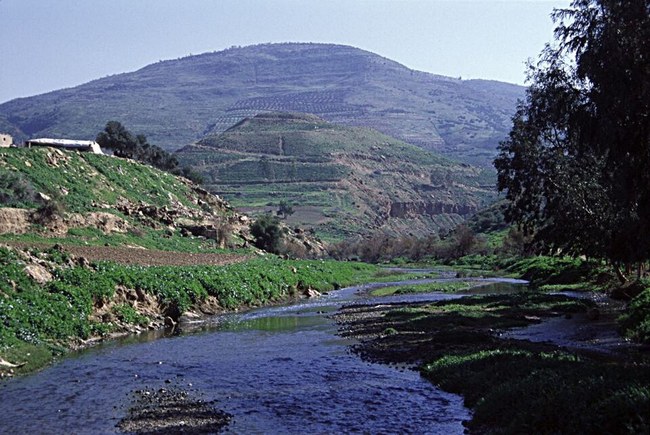
Photo Credit: The Jabbok river and Tulul adh-Dhahab in spring, by E. Rehfeld with CC BY-SA 3.0 license, on Wikimedia Commons.
