

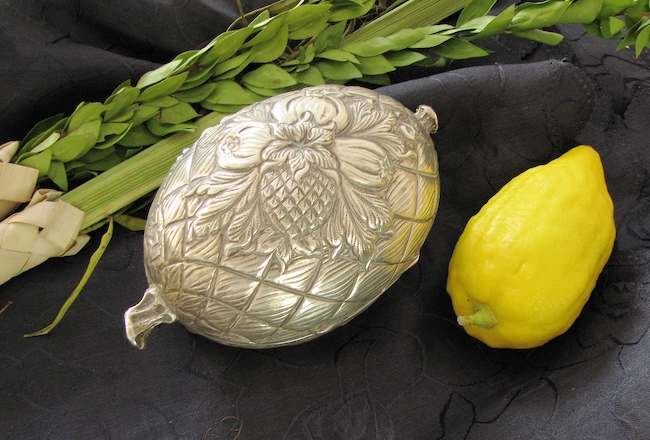
The Medrash (Vayikra Rabbah 30:12) teaches that the four species we take on Sukkos represent four kinds of Jews:
- The esrog has both taste and fragrance, representing those who have both Torah learning and good deeds.
- The lulav, from the date palm, bears fruit with taste but no fragrance, representing those who have Torah but lack good deeds.
- The hadas, a myrtle branch, has fragrance but no taste, representing those who do good deeds but lack Torah.
- The aravah, from a willow bush, has neither taste nor fragrance, representing those who have neither Torah nor good deeds.
Each and every one is included; the Medrash declares it “impossible” that any be discarded or lost. Instead, it says, “Let them all be bound together in one bundle, and they will atone for one another.”
The halachos of the Lulav and Esrog put this idea into practice. The four species are me’akvin — the mitzvah cannot be fulfilled unless all four are present (Menachos 27a). Someone could be holding the finest esrog in the world, but if he doesn’t have the “lowly” aravah he has not fulfilled the mitzvah. The most “accomplished” Jew cannot fulfill his obligation without the one who appears to contribute the least.
Just days ago, in the special prayers for the Yamim Noraim, we said v’ye’asu kulam agudah achas — that all humanity should become “one bundle” to do G-d’s will wholeheartedly. On Sukkos, at least as it pertains to Jews, we take that bundle in our hands.
Notice also what the mitzvah does not say. It does not tell us to blend the species together into something uniform. The esrog remains an esrog, and the aravah remains an aravah. Unity does not mean pretending we are all the same, that all are knowledgeable, or all doing the right thing. It means recognizing that we are bound to one another, and that none of us stands alone.
The Sukkah carries the same message. The Talmud (Sukkah 27b) says that kol Yisrael ra’uyim leishev b’sukkah achas — all of Israel is fit to sit in a single Sukkah.
Our people face no shortage of enemies who don’t distinguish between one Jew and another. We should not need them to remind us of what the lulav teaches every year. Each of us has something the others lack, and each of us needs the others to be whole.
Chag Sameach!
Rabbi Yaakov Menken
Photo Credit: Etrog, silver etrog box and lulav, by Gilabrand with CC BY-SA 3.0 license, on Wikimedia Commons.
