

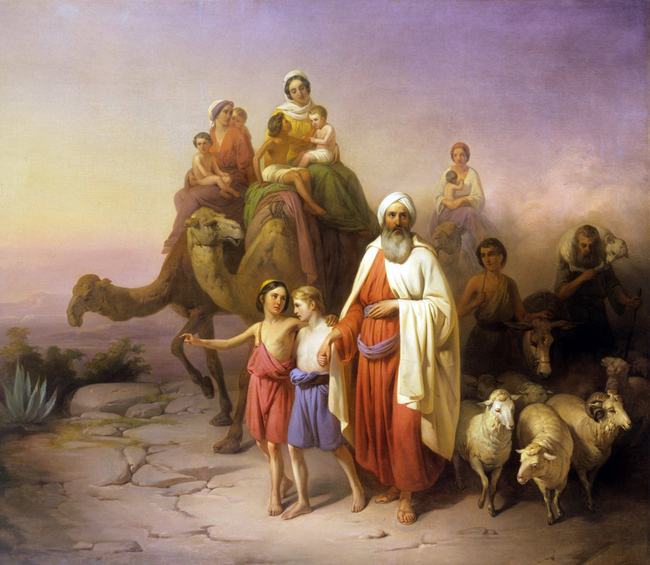
And Sarai was barren; she had no child. (Breishis 11:30)
I graduated from college more than 46 years ago, and I was working on my first real resume job, as a job counselor and a GED teacher for Puerto Rican high school drop out in the Bronx. To inspire the students, we would frequently invite speakers to explain how they managed to pull themselves up and out of their native circumstances. I asked this one man who was an elegantly dressed and well-spoken gentleman. He said he would like to meet the students but only at the Metropolitan Museum of Art where he had once been a curator. I agreed and so on a Tuesday morning we took 80 students on two buses to meet him there. I was unaware that my life was about to change.
He showed us samples of Black, Indian, and Spanish art. Then he sat us all on the marble floor of the hallowed halls of the Metropolitan Museum of Art, as he went into his preacherly cadence. He explained beautifully and powerfully, “The reason I brought you here and showed these cultures and their art is because the Puerto Rican personality is comprised of these three parts and I know that sometimes when you see yourself in the mirror, the black man in you does not like the Spanish or the Indian and the Indian does not like the Spanish or the Black and the Spanish is warring with the Indian and Black within you. If you want to make peace with the world, you have to first make peace with yourself.” I was really enjoying it and so were they as I casually surveyed from the side. Then he added profoundly, “In order to know where you are going in life, you have to know where you are coming from!” He repeated it emphatically and then pivoted to me and said to everyone, “Bobby over here, he knows where he comes from! He’s a son of Abraham! Right?!”
I felt like Bambi on the highway with the headlights bearing down. I didn’t expect to be the subject of his talk and Abraham was not my Bar Mitzvah portion. My visceral reaction was that this is some antisemitic attack but he said nothing pejorative.
In a nanosecond with all the students waiting for me to respond to the challenge of his question, I recalled in Hebrew school reading a chapter that began with an Abram and Sarai beginning a journey from Ur, and so I said aloud and confidently, “That’s right!” Before you say a word, you own the word. After you say it, it owns you.
I ran home to my parents’ house and found the English Bible I received on the occasion of my Bar Mitzvah and I began scanning for any references to Abraham and I found a few quickly. There he is beginning his journey at 75 with a barren wife incapable of having children. I remember thinking that they would probably have been voted in their high school class, “Least likely to make it into the 20th or 21st century and yet here we are. Then I saw Abraham doing extreme acts of kindliness for strangers and it reminded me of stories I had heard about my own beloved great grandfather that I knew. I felt an urge to know more.
I walked around the streets of New York for months saying to myself, “I am a son of Abraham and I know who my great-great-great etc. grandfather is going back 3,700 years.” Then I realized I was looking at it all wrong and I flipped the script and asked myself a question and then just started to write. Along the way I stumbled upon my first of many answers to the question, “How did Avraham and Sara project themselves to being relevant 3,700 years into the future?”, and “What type of parent or grandparent would I have to be that my children or grandchildren should ever care who I was and what I lived for?”
Here’s the first answer I subconsciously penned, “Pebbles in ponds are our ponderings but boulders in oceans were our fathers’ notions, whose waves still rock the sea, whose waves still rock the sea.” I realized that it had little to do with their military might or political prowess but more to do with a certain great idea and if I could find out more about that great idea then perhaps, I could begin to approximate their accomplishments.