


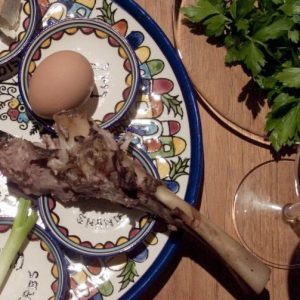
Pesach
The Rosh said something unusual. What is the source for eating a kzayis of moror? The brocha is ‘Al Achilas Moror’ and there is no achila (eating) less than a kzayis! This seems backwards. The brocha should be derived from the mitzva, not the reverse!
The Sha’agas Aryeh questioned as follows: There is a comparison between the Matza and the Moror. Why don’t we say that just as Matza requires a kzayis, so too Moror.
Rav Chaim Brisker answered. Matza and Moror were eaten with the Korban Pesach. The main thing was the Pesach. Really, there shouldn’t be a requirement to eat a kzayis of Matza! It’s only because the Torah repeats a separate command to eat Matza, independent of the Pesach, that we have to eat a kzayis of Matza. However, Moror is only mentioned in connection with the Korban Pesach. It is not mentioned by itself anywhere.
Today, when we don’t have the Korban Pesach, the Rabbis were concerned that we would forget about Moror altogether. Therefore, they decreed to eat Moror by itself, as indicated by the brocha — ‘Al Achilas Moror.’
Kli Yakar on Matza and Chometz
Whenever the Torah mentions chometz, it is hinting to conceit: The flour rises and makes itself great. The korbanos are always matza; one must humble himself in order to come close to Hashem.
At Pesach, chometz is forbidden— even a ‘mashehu’ (a minuscule amount). The reason is that we aim for the golden mean of all characteristics except for anger and conceit. Any amount of conceit is forbidden.
One who needs to express gratitude brings a Korban Todah, with thirty loaves of matza to show that the hardships have subdued him. He also is required to have ten loaves of Chometz in expression of gratitude to the One who uplifts. Ten, corresponding to the ten Sefiros (representing the ten attributes of Hashem).
The Small ‘Alef’
In parshas Vayikra the commentaries discuss the small ‘alef’ in the first word. Ba’al Haturim writes: Moshe didn’t want to emphasize his greatness, that Hashem called to him alone. He wanted to write “vayikar” as the Torah says regarding Bilam (Bmidbar 23:4) — an expression of chance encounter. So Moshe wanted to leave out the letter ’alef’. Hashem would not agree, so they compromised with the small letter “alef.”
Chavatzeles Hasharon: What difference does the small ‘alef’ make? It’s still an ‘alef?’ But Rebbe Akiva Eger writes: Small letters don’t count. All the letters of the Sefer Torah have to be the same size. The small alef is as if it’s nonexistent.
The Small ‘Mem’
In parshas Tzav there’s a small letter ‘mem’ in the word “mokda” (the fireplace), as well. Mayana Shel Torah, in the name of the Kotzker Rebbe explains: a person’s excitement and fervor should stay inside, not apparent to the observer.
Cheichel HeChasom Sofer writes that this was an expression of the character of the Chasom Sofer, as well. His great love and fervor would remain within, not visible to the outside. The exception was the night of Seder. His reading of the Hagada was said with such great passion, that it could be heard outside the house to a distance! This is because the Hagada and the answers to the son should be passed on for the generations so that the son will tell his son as well!
The Four Kosos
Is there a brocha on each of the four cups? This is a dispute, resulting in a difference between the Ashkenazi custom vs. the Sephardi. The Rif explains: The Gemara stated that each and every cup is a mitzva. The Rabonon said from here to make a brocha on each kos.
The Rif compares this to hesech hada’as (break in thought). You cannot drink and say Hallel and Hagada at the same time. Therefore, each cup would require a new brocha. But others say it is merely because of the mitzva to drink four cups; they consider the brocha ‘borei pri hagafen’ at the Seder a brocha of mitzva.
Be Grateful For Mitzvos
There is an obligation to thank for mitzvos as well as pleasures; eg. to be grateful that Hashem sent me wine to fulfill the mitzva. Rav Shlomo Zalman Auerbuch: Brochos for benefit are only if you have some pleasure from the eating or drinking. However, if the consumption causes you pain, you wouldn’t make a brocha. Yet you are obligated to drink four cups of wine even if it causes you pain — so you see, we should have to make the four brochos on wine because of the mitzva therein, not because of the pleasure.
Hageonim held that each cup needs a Brocha Achrona! Because of this doubt, the Chofetz Chaim advised not to drink the whole cup of Kiddush on a normal Shabbos night. According to some opinions, you would have to make a Brocha Achrona before washing for bread. On Shabbos, just drink enough to fill your cheeks (malei lugmav). Of course, at the Seder the minhag is not to make any Brocha Achrona until the end of the Seder.
The strange thing is that we make one Brocha Achrona on all four cups. There have been hours in between! The Gaon explained that since it’s all in one sitting, the amount of time doesn’t matter.
Why Were You Commanded?
At the beginning of Parshas Tzav, Rashi says ‘tzav’ (the word for command) indicates zerizus (alacrity). So too, in the Seder, the Ben hachachom asks, “What are the testimonies … that Hashem … has commanded you?” He uses that same language of tziva (command) — which indicates alacrity. The Chasom Sofer explains: This is the second part of the wise son’s question — why did Hashem have to ‘command’ intelligent people like you — that you should act with alacrity?
The father answers “Don’t eat anything after the Pesach Afikoman.” We have to see ourselves each and every day as newly born commanded, as if we were commanded today! Let this taste remain in your mouth all year…