

בס”ד
Volume 41, No. 5
27 Cheshvan 5787
November 7, 2026
Sponsored by
the Parness family
in memory of Max Parness a”h
This week’s Parashah opens with Avraham’s purchase of the Me’arat Ha’machpelah from Efron the Hittite. The Gemara (Bava Metzia 87a) contrasts Avraham and Efron. The former said (at the beginning of last week’s Parashah), “I will fetch a morsel of bread,” but he actually served his guests cream and milk and a tender calf. In short, Avraham embodied the statement: “Tzaddikim say little and do a lot.” In contrast, Efron offered to give Avraham the Me’arat Ha’machpelah for free but, in the end, he demanded 400 of the highest quality silver coins. Thus, Efron embodied: “Resha’im say a lot and do little.”
R’ Uri Weisblum shlita (Mashgiach Ruchani of Yeshivat Nachalat Ha’levi’im in Haifa, Israel) writes: When our Sages praise the righteous for saying little and doing a lot, the emphasis is not on the fact that they keep their word and do even more than they promised. Rather, it is on the fact that they speak only when and to the extent necessary. Speech, explains R’ Weisblum, is the defining characteristic of a human being and is how the soul interacts with the physical world (see Onkelos to Bereishit 2:7). Accordingly, speech should be used with care–not like the wicked who enjoy hearing the sound of their own voices or who, like Efron, use speech solely to bring honor to themselves.
R’ Weisblum elaborates: The Torah describes Efron’s offer to give Avraham the Me’arat Ha’machpelah as follows (23:10), “Efron the Hittite responded to Avraham in the hearing of the children of Chet, for all who come to the gate of his city, saying . . .” Efron’s offer was not sincere; he was speaking for public consumption.
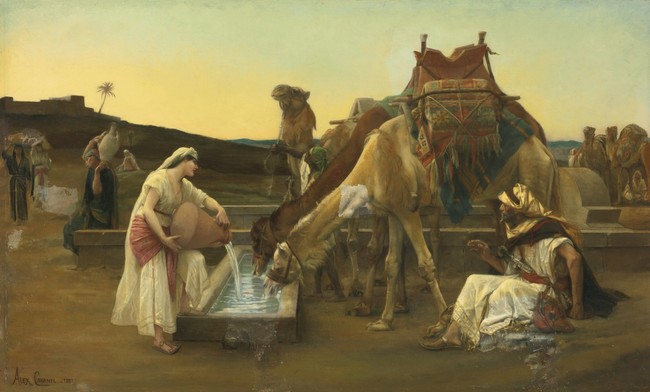
In contrast, a righteous person’s care with speech is illustrated later in our Parashah, where we read about Rivka (24:18-19), “She said, ‘Drink, my lord,’ and quickly she lowered her jug to her hand and gave him to drink. When she finished giving him to drink, she said, ‘I will draw water even for your camels until they have finished drinking’.” When Eliezer retells the chain of events, he misquotes Rivka as saying (24:46), “Drink, and I will even water your camels.” R’ Weisblum explains: Rivka did not mention watering the camels until Eliezer and his men had finished drinking, for there was no purpose in offering that additional kindness when she was busy with the first kindness and unavailable to perform the second one. Eliezer missed that subtlety, however, so he merged Rivka’s two statements into one.
Later still in the Parashah, we again see how the wicked speak. We read (24:50-51), “Then Lavan and Betuel answered and said, ‘The matter stemmed from Hashem! We can say neither bad nor good to you. Here, Rivka is before you; take her and go, and let her be a wife to your master’s son as Hashem has spoken’.” Despite that very clear recognition of Hashem’s Will, Rivka’s family did an about-face the very next morning (24:55), “Let the maiden remain with us a year or ten [months]; then she will go.” Such is the way of the wicked. (He’arat Ha’derech p.315)
Shlomo Ha’melech teaches (Mishlei 17:27), “One who is sparing with his words knows knowledge, and a man of understanding speaks sparingly.” R’ Yehuda Loewe z”l (Maharal of Prague; died 1609) writes: Shlomo Ha’melech is not saying that a person should never speak. Rather, he is saying that silence is preferable when there is no need to talk. Nevertheless, Maharal adds, our Sages agree that total silence is undesirable, for man is meant to be a social creature. It is excessive speech that is not only undesirable, but Halachically prohibited. (Netiv Ha’shetikah ch.1)
********
“Avraham came to eulogize Sarah and to bewail her.” (23:2)
One of the most famous expressions uttered by a husband about his wife is Rabbi Akiva’s statement to his students, “Everything that I have and everything that you have –it is hers.” But was this really true? While Rabbi Akiva’s wife agreed to suffer deprivation while he was away in Yeshiva, it was he who toiled in study to become one of the greatest Tana’im / Sages of the period of the Mishnah–indeed, of all time!
R’ Shalom Aroush shlita (Yerushalayim) explains: A marriage is more than a union of two bodies. It is a union of two souls. When a marriage works properly, the husband’s soul and the wife’s soul are one, in the same way that a pair of legs operates as a unit. We do not see a person’s two legs as separate limbs that complement each other. Rather, we view them as a pair that we expect to work in tandem.
Rabbi Akiva understood this, and he understood that his soul drew spiritual strength from the very special soul of his wife. And, he knew, and told his students, that his accomplishments were possible only because of that additional spiritual strength that he received from his wife’s soul. (B’gan Ha’shalom p.120)
********
“Let it be that the maiden to whom I shall say, ‘Please tip over your jug so I may drink,’ and who replies, ‘Drink, and I will even water your camels,’ she will You have designated for Your servant . . .” (24:14)
“She said, ‘I will draw water even for your camels . . .’” (24:19)
“Let it be that the young woman who comes out to draw and to whom I shall say, ‘Please give me some water to drink from your jug,’ and who will answer, ‘. . . I will draw water for your camels, too . . .’” (24:43-44)
“So I drank and she watered the camels also.” (24:46)
R’ Pinchas Zalman Horowitz z”l (1832-1906; Krakow, Galicia) writes: Drawing water and watering the camels, i.e., giving each of the camels water to drink, are two separate processes–the latter being substantially more difficult than the former. In verse 14, we see that Eliezer prayed that he find a girl who would not only draw water for the camels, but who also would water them.
In verse 19, we see that Rivka offered only to draw water; she did not offer to water the camels. However, verse 46 relates that Rivka did, in fact, water the camels. This teaches us that Rivka practiced the Middah / trait taught in Pirkei Avot (ch.1): “Say little and do a lot.”
In verse 44, we read that when Eliezer retold the story to Rivka’s family, he did not mention that he had prayed to find a girl who would water the camels, only that he had prayed for a girl who would offer to draw water for the camels. Eliezer changed this detail because he did not think Rivka’s family would appreciate hearing that he had such grand expectations. (Ahavat Torah)
********
“It was, when the camels had finished drinking, the man took a golden nose ring, its weight was a Beka, and two bracelets on her arms, ten gold shekels was their weight.” (24:22)
Why did Eliezer wait until the camels had finished drinking before giving Rivka these gifts? R’ Shimshon Dovid Pincus z”l (1944-2001; rabbi of Ofakim, Israel) answers: Eliezer waited to see whether, after performing an incredible act of kindness, Rivka would wait for payment, or at least a compliment. But she did not; she turned around to leave as if she had done nothing remarkable. Then Eliezer knew that she was truly remarkable, so he gave her the gifts. (Tiferet Shimshon)
********
Shabbat
R’ Aharon Roth z”l (1894-1947; Shomer Emunim Rebbe in Hungary and Yerushalayim) relates a parable:
A man needs to travel from home–whether it is because he sinned against the king and was exiled, because he was appointed by the king as an ambassador, or for some other reason. He travels far from his family and he dwells alone, becoming increasingly lonely. From time-to-time, he experiences moments of joy–perhaps, for example, when he sees his mission succeeding–but that joy pales in comparison to the happiness he would have had sitting at home with his wife and children. With great anticipation and longing, he awaits the day when his exile or his ambassadorial term will end, and he will be able to return home.
One day, he looks up and sees someone familiar coming toward him. As the new arrival approaches, the exile realizes that the person is a close friend from back home. Imagine the joy! And, how much greater would the joy be if the new arrival were a relative!
The new arrival explains that the king has sent him to keep our traveler company and to lessen his loneliness. When our traveler hears this, he is filled with gratitude for the king’s compassion–in particular, if he is lonely because he was exiled for committing a serious offense against the king.
R’ Roth explains to what the parable refers: Our souls come from very lofty places in Heaven, and they are sent far away from their “roots”–either as ambassadors, to accomplish specific missions in this world, or as exiles, to repair some damage that they committed in their prior existence. Either way, a soul’s “homesickness” while it is in this world is immense.
On the Holy Shabbat, a “visitor” is sent from Heaven to keep the lonely soul company. That “visitor” is the Neshamah Yeteirah / the “extra soul.” Each Jew receives a Neshamah Yeteirah from his “hometown,” so-to-speak–i.e., each person’s Neshamah Yeteirah comes from the same unique spiritual “root” as his own Neshamah, so that it will be an appropriate companion for his or her soul. For this reason, the Neshamah Yeteirah brings a person’s soul great happiness on Shabbat. (Shulchan Ha’tahor p.257)