


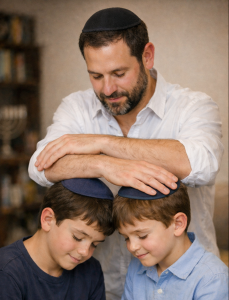
On Friday night, it is traditional for fathers to bless each child before the Sabbath meal. For daughters, we bless them by remembering the mothers of the nation: “May Hashem place you like Sarah, Rivka, Rachel and Leah.”
For sons, however, we do not recall the forefathers in these blessings. Instead, we say “May Hashem place you like Ephraim and Menashe,” referring to Joseph’s sons, born before Yaakov and the rest of the family came down to Egypt.
The source for this is in the Torah, in our reading this week. When Yaakov blessed Ephraim and Menashe, his grandchildren, he blessed them [48:15-16] and then added, “And he blessed them on that day, saying, ‘in you shall Israel bless [their children], saying, “May Hashem place you like Ephraim and Menashe,”’ and he placed Ephraim in front of Menashe” [48:20].
The Igreh D’Kallah asks a simple question: why, indeed, do we bless boys using Ephraim and Menashe as their models, rather than our holy forefathers?
When Yaakov blessed his grandsons, he crossed his arms, placing his right hand on Ephraim, the younger son, and his left on Menashe, though he was the first-born [48:14]. And when his son, Yosef, protested, Yaakov said that he knew which was which, but “his younger brother shall grow greater than he” [48:19]. Rashi says that Yaakov saw prophetically that Yehoshua, who would lead Israel into the Promised Land, and who taught them Torah, would come from Ephraim.
This risked, of course, bad feelings arising between the two brothers. Yaakov knew this better than anyone; his other sons had been so jealous of his favoritism towards Yosef that they had sold him into slavery! Yet this did not happen, at all, to Ephraim and Menashe.
This, the Igreh D’Kallah explains, is why they became our examples of what a man should be. It is a fundamental principle in the Torah that a person should neither become vain nor jealous regarding others. When Yaakov placed his right hand on Ephraim and left on Menashe, he saw that haughtiness did not result for Ephraim, and resentment did not result for Menashe. Both remained as they were. And this is why Yaakov said that all the Children of Israel should bless their boys to be like them, without pride or envy.
Going further, he says that this explains the closing words of Yaakov’s added blessing, “and he placed Ephraim in front of Menashe,” which appear to be repetitive—the fact that Yaakov placed Ephraim before Menashe is mentioned several times in this passage. These words, he says, explain why Yaakov blessed them by saying “May Hashem place you like Ephraim and Menashe.” Since it was true that Yaakov had placed Ephraim before Menashe, yet they remained unaffected, it was for this reason that, per his blessing, we continue to use these two brothers as our model, for all of Jewish history.
May we, indeed, strive to be like Ephraim and Menashe, with neither pride nor envy!
Good Shabbos,
Rabbi Yaakov Menken
P.S. For another explanation of why Ephraim and Menashe are the models when blessing boys, see “To Pack Your Parachute” by Rabbi Label Lam, linked below!