

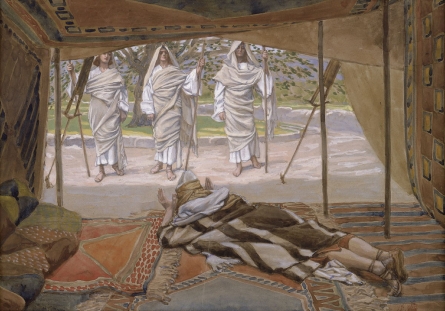
Avraham, Sarah and Lot
Dovid Hamelech descended from Rus, who was a Moabite woman. Now, the Torah states that Moabites cannot enter into Klal Yisrael. How could Dovid be Jewish? The Gemara debates this in Yevamos. Rebbi Shimon explains that the Torah gives a reason for the exclusion of Moabites “because they did not come out to greet you with bread and water.” This only applies to men, whose way is to go out, but not to women who do not go out to greet with bread and water. So it states in Tehilim: “The honor of the princess is within.” In Eretz Yisrael or some say Rebbi Yitzchak said, from here: The malachim asked, “Where is Sarah your wife? And he answered, She is in the tent.”
The Chidushei Harim explained that Lot merited being saved because Dovid Hamelech would be descended from him. If it could be proved that the woman stays inside, then the Moabite women would be exempted from the prohibition of Moabites entering into Klal Yisrael. This novel permission is derived from Avraham and Sarah, for Sarah remained inside.
With this background, the Chidushei Harim answered a well-known question. Rashi says that there were three Malachim because a malach can only do one assignment. But the malach that healed Avraham also went to save Lot! (1)
The Chidushei Harim (quoted in Mayana Shel Torah) explains that Lot was only saved because of Dovid Hamelech, but until Avraham said “She is in the tent,” the Halacha had not been determined if the prohibition of Moavi entering Klal Yisrael was only for the males and not the females. Consequently, it was not determined if Dovid would be acceptable as yet. Therefore, a special malach was not sent for Lot, because his situation had not been clarified. The Chidushei Harim says that the Halacha in Shomayim is determined by the Halacha on earth.
Rav Moshe’s Famous Drosh
Rav Yisrael Belsky related a Shabbos Hagadol drosh of Rav Moshe Feinstein. In the haftara of that Shabbos (Malachi, 3:13-14) Hashem says “Your words are too strong for Me, and you say, ‘What have we said?’ You said, ‘The service of Hashem is worthless, what profit is there that we keep it, and blacken our faces by serving Hashem.’”
Rav Moshe asked, “How could they say they said nothing? ‘The service of Hashem is worthless!’ What worse thing could they possibly have said?”
Rav Moshe explained that we are not discussing people who have abandoned Yidishkeit; quite the contrary — we’re talking about people who are very careful in every detail of observance, and consider themselves to be tzadikim. But they kvetch and let everyone hear their problems. Hashem is saying that you’re giving the impression that you’re unfortunate, that the service of Hashem is a burden. The children pick up on this, and want to leave this burden… They want to leave Yidishkeit.
Rather, the parents should strive to be happy, and convey to their offspring that Yidishkeit brings happiness. Rav Belsky said that Rav Moshe was the happiest person he ever saw! This, said Rav Belsky, is the foundation of Judaism — to always be happy.
Avraham’s Simcha
Avraham accepted all of his tests with joy, even to give up his son… The Chasom Sofer (2) said that not only that, but when the malach told him not to give up his son, he accepted this with joy also (even though he had been so worked up).
Our simcha is the knowledge that Hashem is with us. We say in Ma’ariv, “Your love will never leave us, Baruch Attah Hashem, Who loves his people Yisrael.”
————————————————————————————
1.Tosafos (B. M. 86b) and the Gemara give two explanations. One, healing and saving are the same mida, so they’re not considered two different assignments. Secondly, the limitation of of one assignment is only in one place, not two places. Still, why hadn’t Hashem sent another malach? See Sha’arei Aharon.
2.In the name of Rav Shmelka of Nikolsberg. (Heichel Chasom Sofer)