
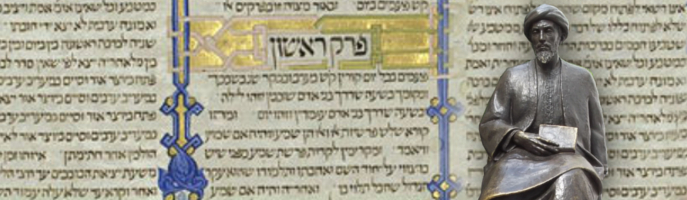
Halacha Overview
By Rabbi Dr. Azriel Rosenfeld
This class presents an overview of Jewish Law based on the Rambam’s Mishneh Torah, the comprehensive code of Moses Maimonides. Summaries of each section of the Mishneh Torah present the reader with a basic understanding of the topics covered. Thus the class participant acquires knowledge about the breadth of the Halachic system.
The course material is presented by Rabbi Dr. Azriel Rosenfeld, who received Rabbinic ordination from the Rabbi Isaac Elchonon Theological Seminary of Yeshiva University. He is the Director of the Center for Automation Research at the University of Maryland in College Park and is a past president of the Association of Orthodox Jewish Scientists.
Foreword
The purpose of this course is to present a concise introduction to the halachah — Jewish religious law. Since Maimonides’ Mishneh Torah (“Second [to the] Torah”) is the one major code that covers all of Jewish law, it is the natural source to use in compiling such an introduction.
The organization of the Mishneh Torah (henceforth:MT) into 14 books and 83 sections has been followed; a list of these is given on the following pages. The head notes at the beginnings of the books have been translated in full. Each section of the course is a concise summary of the corresponding section of MT*.
The selected material covers the 613 commandments (mitzvos) of the Torah and summarizes general halachic principles dealing with each commandment. [A more extensive abridgment of MT is available in English translation by Philip Birnbaum; and many of the volumes of MT have been fully translated as part of the Yale University Judaica series.] It must be stressed that one should not use MT — and certainly not a summary of it — as a basis for practical halachic decisions; when such decisions are required a qualified rabbi should be consulted.
*MT chapter and paragraph numbers on which the summary is based are cited in footnotes. These are indicated by letter superscripts to distinguish them from the numbered footnotes which give the sources of Biblical and Talmudic quotations.
A note on transliteration: In transliterating Hebrew terms I have generally followed the Ashkenazic pronunciation of the consonants. The guttural letters “ches” and “chof” are both transliterated as “ch” (pronounced as in “Bach”). Doubling of consonants that contain a dagesh has been done only when it is inaccordance with convention.
Subscribe to Halacha Overview and receive this class via e-mail.